League of Legends Stats Explained: KDA, CS, Win Rate & More
Learn how to read League of Legends stats, including KDA, CS per minute, win rate, vision score and damage. Improve your gameplay with practical tips.
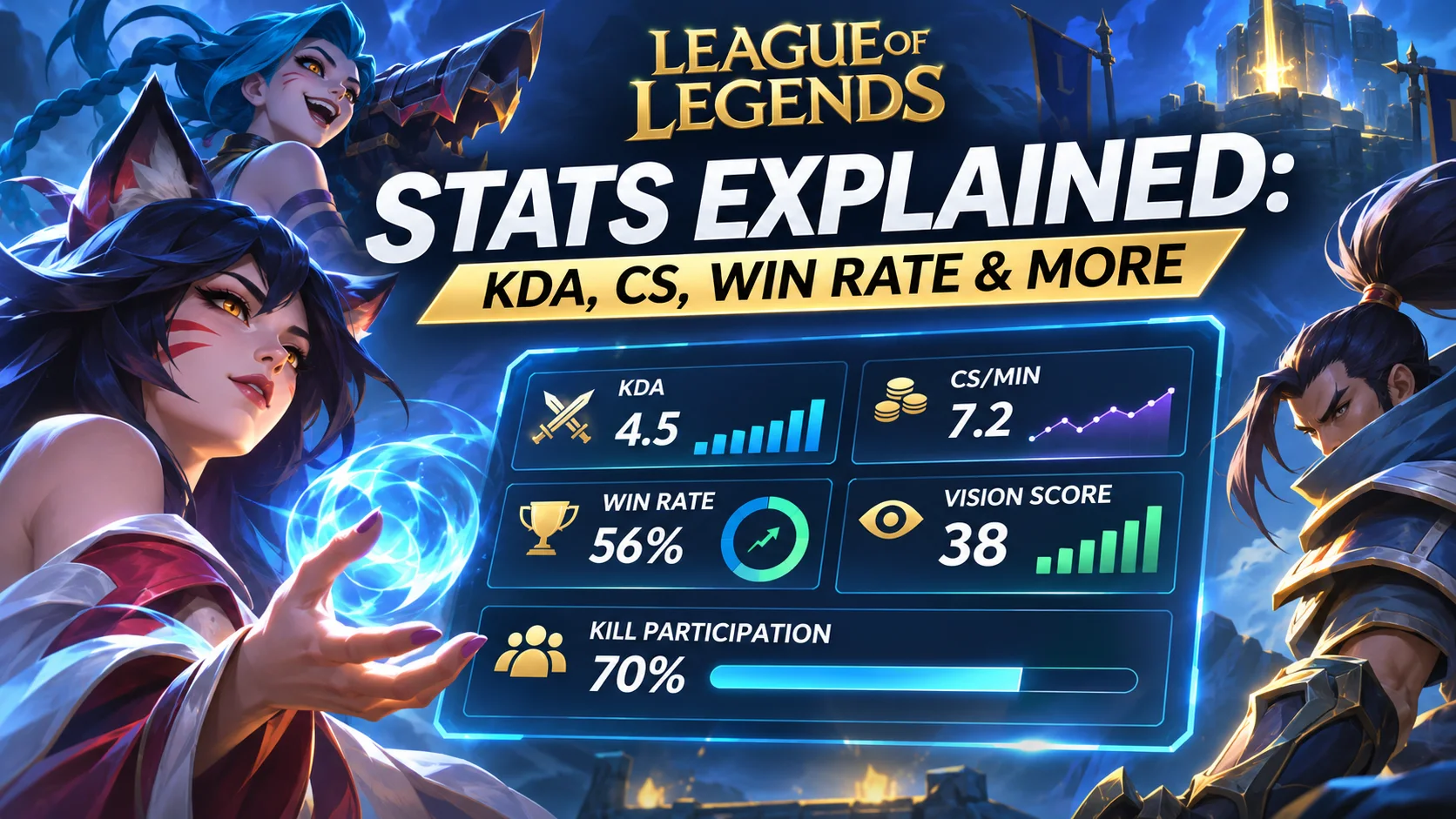
League of Legends Stats Explained: KDA, CS, Win Rate & More
Understanding League of Legends stats is one of the easiest ways to identify weaknesses in your gameplay. Whether you're climbing through Bronze, pushing toward Diamond, or analyzing professional matches, the right statistics can reveal far more than your final kill count.
But which numbers actually matter? Is a high KDA always good? How much CS should you have at 10 minutes? And why can a player with fewer kills still have a greater impact on the game?
This guide explains the most important LoL stats, how to calculate them, and how to use them to improve.
What Are League of Legends Stats?
League of Legends statistics are performance measurements recorded throughout a match. They help players understand individual contributions, team performance, and long-term trends.
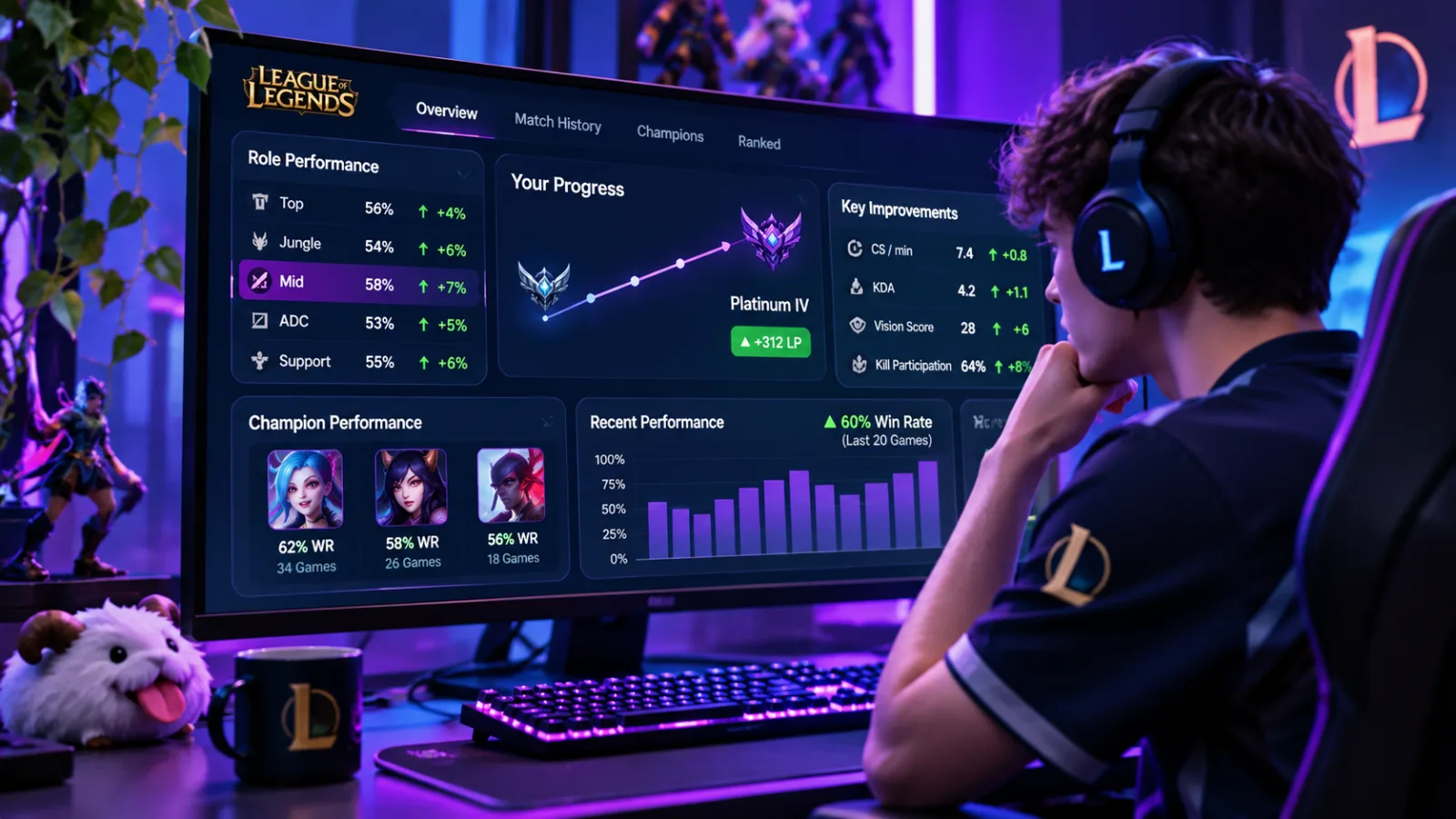
The most useful statistics include:
- KDA: Kills, deaths, and assists
- CS: Minions and monsters killed for farm
- CS per minute: Farming efficiency
- Win rate: Percentage of matches won
- Vision score: Contribution to vision control
- Damage dealt: Damage inflicted on enemy champions
- Gold earned: Total economic resources collected
- Kill participation: Involvement in team kills
Not every statistic matters equally for every role. A support player should generally prioritize vision, utility, and teamfight contribution, while an ADC often focuses on farming, damage output, and positioning.
1. KDA: What Does It Mean in League of Legends?
KDA stands for Kills, Deaths, and Assists. It is one of the most recognizable League of Legends stats.
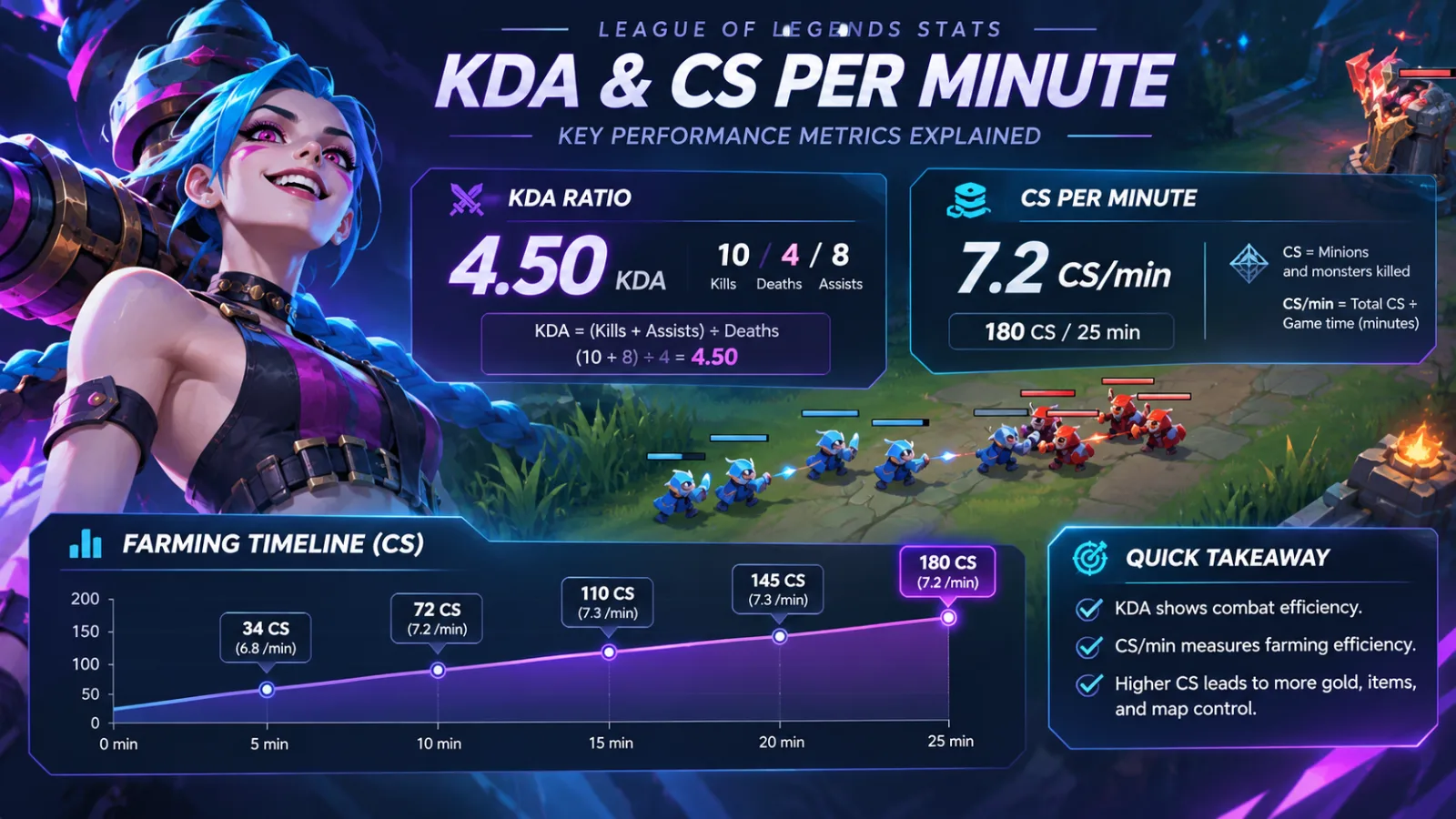
The standard KDA ratio is calculated as:
KDA = (Kills + Assists) / Deaths
For example, a player finishing with 10 kills, 4 deaths, and 8 assists has:
(10 + 8) / 4 = 4.5 KDA
When a player has zero deaths, the mathematical ratio is undefined, and different tracking platforms may display it differently.
What Is a Good KDA?
There is no universal benchmark, but these approximate ranges can help provide context:
| KDA Ratio | General Interpretation |
|---|---|
| Below 2.0 | Potentially inconsistent |
| 2.0–3.0 | Reasonable performance |
| 3.0–4.0 | Strong performance |
| 4.0–5.0 | Very strong performance |
| Above 5.0 | Excellent on paper |
These are informal guidelines, not official Riot Games rankings.
A player with a 6.0 KDA can still lose games through poor objective decisions, while a tank with a lower KDA may contribute enormously through initiation and crowd control.
The important lesson: KDA measures combat efficiency, not total game impact.
2. CS Per Minute: Why Farming Matters
CS stands for Creep Score. It represents the number of minions and certain monsters a player has killed.
Farming consistently provides gold and experience advantages, helping players purchase items earlier than their opponents.
CS per minute is calculated as:
CS/min = Total CS / Game Duration in Minutes
For example, 180 CS in a 25-minute match equals 7.2 CS per minute.
What Is Good CS Per Minute?
| CS/min | General Assessment |
|---|---|
| Below 4 | Low for a farming laner |
| 4–5 | Developing consistency |
| 5–6 | Moderate |
| 6–7 | Solid |
| 7–8 | Strong |
| 8–9 | Excellent |
| 9+ | Exceptional in favorable conditions |
These ranges mainly apply to farming lane roles. Supports and junglers should not be evaluated using the same expectations.
High-level players often maintain strong farming numbers while still participating in fights and objectives.
How to Improve Your CS
Practice last-hitting without abilities, learn wave management, and avoid unnecessary recalls that cause you to lose entire minion waves.
A useful training exercise is to enter Practice Tool and farm for 10 minutes without an opponent. Record your result and try to improve your consistency over multiple sessions.
3. Win Rate: The Most Important Long-Term Statistic?
Win rate measures how frequently you win matches.
The formula is simple:
Win Rate = (Wins / Total Games) × 100
If you win 55 out of 100 ranked games, your win rate is 55%.
However, sample size matters enormously.
A player with a 70% win rate across 10 games has less reliable evidence of consistent performance than someone maintaining 55% across 200 games.
How to Interpret Win Rate
- Below 50%: You are losing more games than you win over the measured sample.
- Around 50%: Results are relatively balanced.
- 52–55%: A positive win rate that may support climbing.
- 55–60%: Strong results across a meaningful sample.
- Above 60%: Excellent results, especially over many matches.
Ranked progression also depends on matchmaking rating and LP gains or losses, so win rate alone cannot predict how quickly someone will climb.
4. Vision Score: The Most Underrated LoL Stat
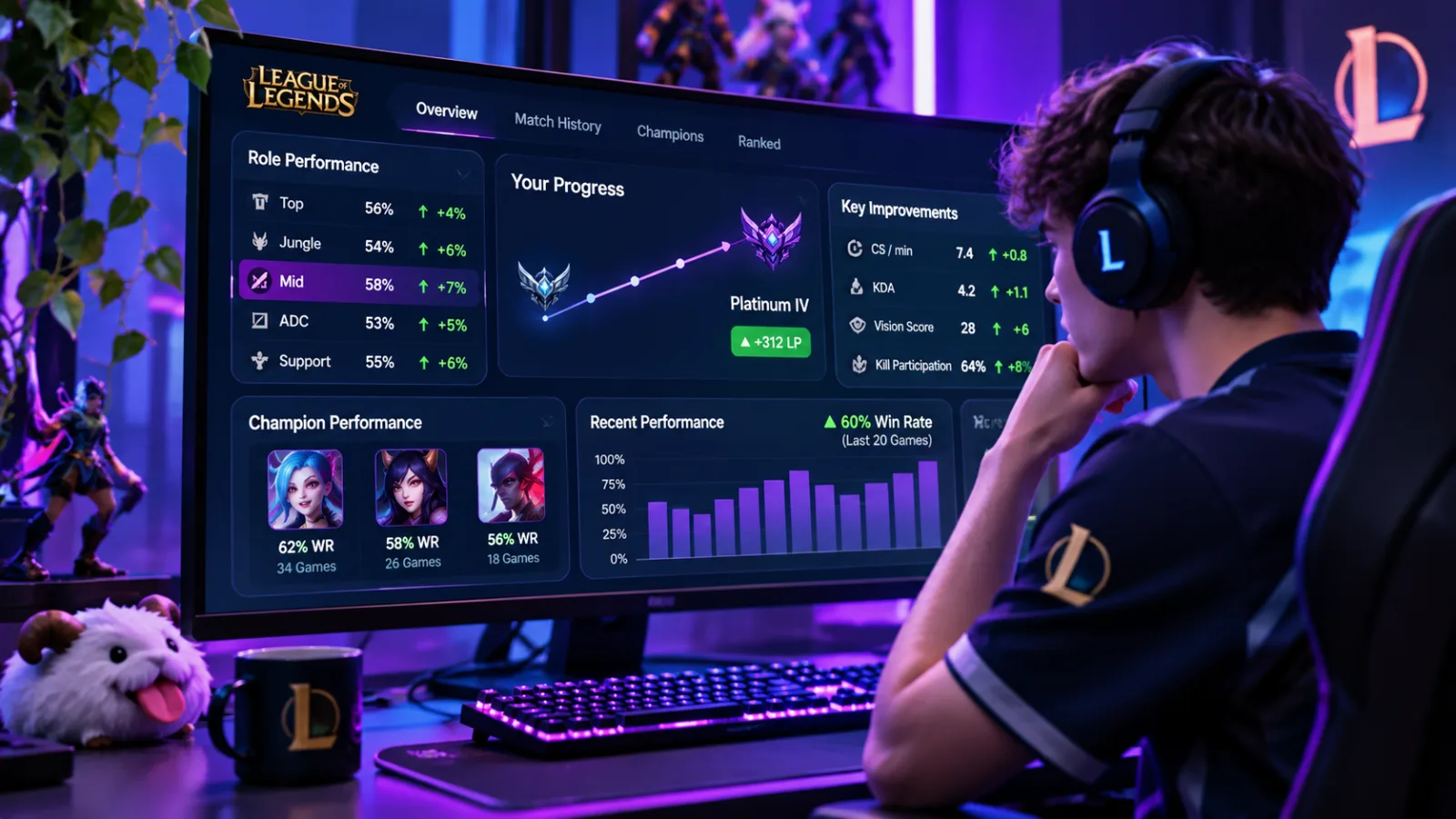
Vision score estimates how much useful vision a player contributes through wards, clearing enemy vision, and related actions.
Vision helps teams track enemy movement, avoid ambushes, and prepare for objectives such as Baron Nashor and dragons.
Supports typically accumulate higher vision scores because their role involves placing and clearing wards throughout the game.
However, junglers, mid laners, and other roles should also contribute to map control.
How to Improve Vision Score
Place wards before major objectives, use Control Wards strategically, and clear enemy wards when it is safe.
Avoid placing wards simply to increase a number. A ward that reveals an approaching jungler or helps secure Baron can be more valuable than several poorly positioned wards.
5. Damage Dealt vs. Actual Game Impact
Damage to champions is another widely tracked statistic.
High damage numbers can indicate strong combat participation, but they require context.
For example, a champion repeatedly damaging a durable tank may accumulate enormous damage without securing meaningful advantages.
Meanwhile, an assassin who eliminates an enemy carry before an objective fight may deal less total damage but create a decisive opportunity.
When analyzing damage, consider your champion, role, team composition, and the circumstances of each fight.
Damage charts become more useful when compared across multiple games rather than judged from one match.
6. Kill Participation: Measuring Teamfight Involvement
Kill participation measures how frequently you contribute to your team's kills.
Kill Participation = (Kills + Assists) / Team Kills × 100
Imagine your team finishes with 30 kills, while you record 8 kills and 13 assists.
Your kill participation is:
(8 + 13) / 30 × 100 = 70%
That means you contributed to 70% of your team's kills.
This statistic is particularly useful for evaluating junglers, supports, and champions expected to influence multiple areas of the map.
However, split-pushing champions may have lower participation while creating significant pressure elsewhere.
7. Where Can You Check League of Legends Stats?
Several platforms allow players to review their performance and match history.
Riot Games Client
The League of Legends client provides match history and post-game statistics, including combat performance, farming, and other match information.
OP.GG
OP.GG offers player profiles, ranked statistics, champion performance, and match history.
It is useful for reviewing recent games and identifying frequently played champions.
League of Graphs
League of Graphs provides detailed performance statistics, champion trends, and comparisons across different ranks.
U.GG
U.GG focuses on champion statistics, builds, rankings, and matchup information.
It can help players compare champion performance across different roles and ranked tiers.
Third-party statistics may differ because of their data samples, filters, and update schedules.
8. How to Use LoL Stats to Improve Your Rank
The biggest mistake players make is tracking too many statistics without knowing what to improve.
Instead, identify one or two metrics that directly relate to your role.
For example:
Top Lane: Focus on CS per minute, deaths during the laning phase, and objective pressure.
Jungle: Analyze objective control, kill participation, farming efficiency, and successful map pressure.
Mid Lane: Track farming consistency, deaths, roaming impact, and damage contribution.
ADC: Prioritize CS per minute, positioning-related deaths, and damage output in teamfights.
Support: Focus on vision control, kill participation, and effective map movement.
Review at least 10–20 games before making major conclusions. Look for recurring patterns rather than reacting to one unusually good or bad performance.
Frequently Asked Questions
What is the most important stat in League of Legends?
Win rate is an important long-term outcome metric, but individual improvement usually requires examining farming, deaths, vision, and role-specific performance.
Is a 3.0 KDA good in LoL?
A 3.0 KDA is generally a respectable ratio, although its significance depends on champion, role, rank, and playstyle.
Is 7 CS per minute good?
Seven CS per minute is generally solid for a farming lane champion, particularly in games with frequent fights. Expectations differ by role and match circumstances.
Can you climb with a negative KDA?
Yes. Players can contribute through objectives, utility, vision, and map pressure even when their kill-death statistics are unimpressive.
Are League of Legends stat websites accurate?
Most established platforms use Riot-related game data, but differences in sampling, regional coverage, and update frequency can produce different results.
Understanding League of Legends stats is about identifying patterns, not chasing impressive numbers.
KDA, CS per minute, win rate, vision score, and kill participation each reveal different aspects of gameplay. None tells the complete story alone.
If you want to improve, start by tracking a small number of meaningful metrics, review your matches consistently, and focus on decisions that help your team win.
The best League of Legends players do not simply produce strong statistics. They understand how their actions translate into victories.
Tim Buysse
Author & FounderEsports strategist, entrepreneur, and author. Founder of No Noob Agency (nonoob.gg) and Runningvibes (runningvibes.be), covering competitive gaming, digital strategy, and performance.