The Psychology of Crash Games: Multiplier Curves, Pacing & The Math Behind the Burst
Why have simple multiplier crash games exploded in popularity alongside retro arcades? Here is an engineering breakdown of exponential multiplier curves, Provably Fair SHA-256 seed hashing, and the psychology of manual cash-outs.

Exponential Tension: How Crash Games Mastered Modern Interactive Pacing
In an era of hyper-realistic 4K graphics, open-world gaming engines, and cinematic storytelling, one of the fastest-growing categories in modern digital entertainment is visually minimalist: a simple line, plane, or rocket ascending an exponential multiplier curve before abruptly crashing.
Known across the industry as "Crash Games" or Burst Mechanics, titles like Aviator and Space XY have captured massive audiences. They strip away complicated paytables, rotating reels, and intricate storylines, replacing them with a single, high-stakes psychological decision: Do you cash out now with a modest multiplier, or hold on for a massive score before the line snaps?
Below is an engineering and psychological breakdown of how crash algorithms operate, the mathematical equation governing the multiplier, and why player agency makes the mechanic uncommonly compelling.
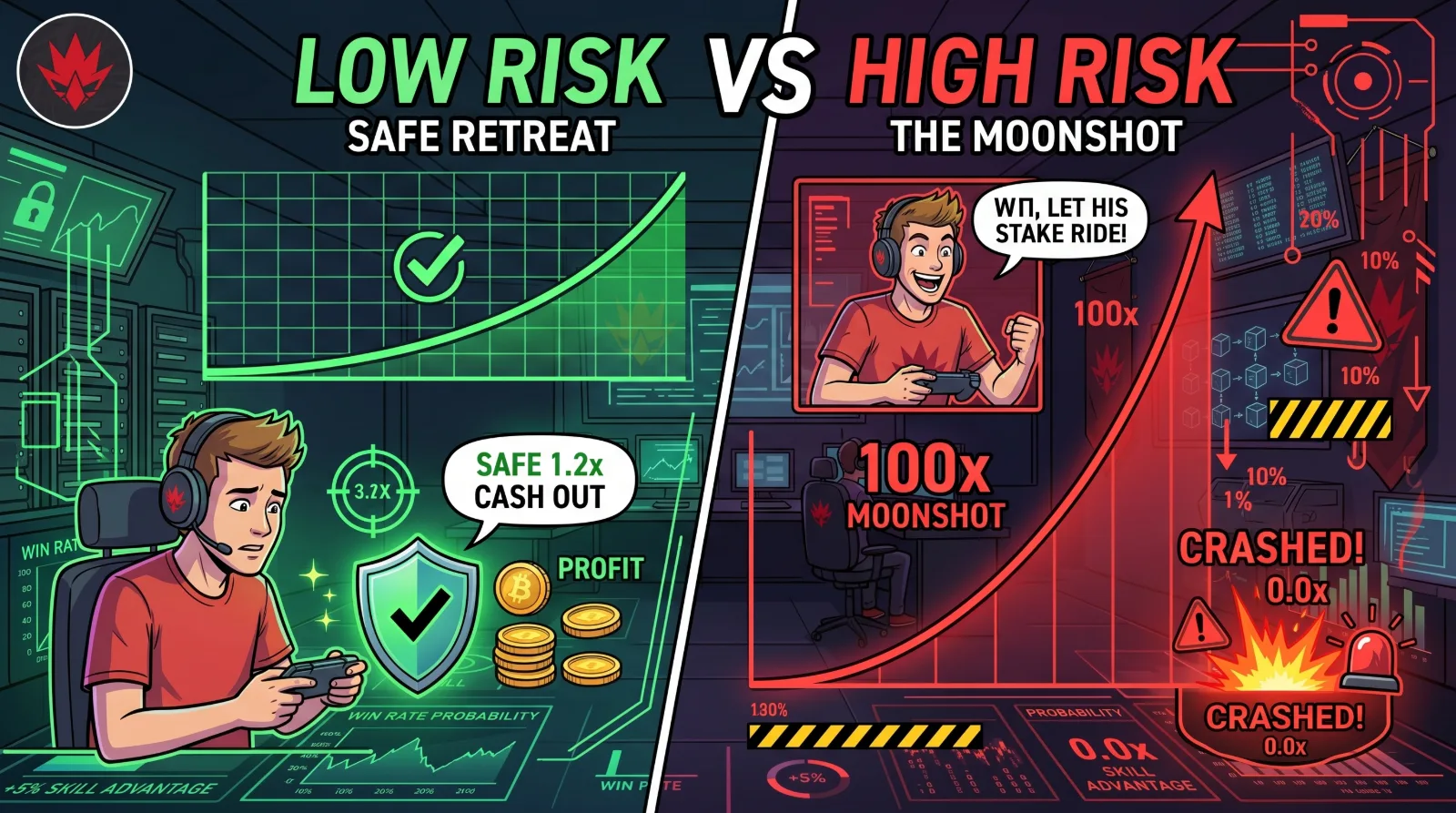
The Mathematical Engine: How Multiplier Curves Are Calculated
Crash games appear continuous, but the exact moment of the crash is mathematically predetermined before each round begins using a standardized probability distribution:
$$\text{Multiplier} = \frac{100}{100 - X} \times (1 - \text{House Edge})$$
Where $X$ is a pseudorandom number generated between 0 and 100.
Multiplier Probability Decay:
[========================================= ] 1.10x Multiplier (Over 89% Success Probability)
[==================== ] 2.00x Multiplier (Roughly 48% Success Probability)
[==== ] 10.0x Multiplier (Roughly 9.6% Success Probability)
[= ] 100x Multiplier (<1% Astronomical Moon-Shot)
- Instant Busts: Every crash game features an immediate crash zone (crashing at
1.00x), which accounts for roughly 1% to 3% of all rounds. This built-in mathematical buffer guarantees the platform's long-term operating margin regardless of player betting patterns. - The Illusion of Control: Because the player physically clicks the Cash Out button, human psychology registers the outcome as a skill-based reaction test rather than an encounter with probability math.
Provably Fair Cryptography: Verifying the Hash
The technical breakthrough that propelled crash games into mainstream entertainment was the implementation of Provably Fair algorithms:
- Server Seed: The platform generates a secret seed hashed with SHA-256 before the round begins, publishing the encrypted hash to the lobby.
- Client Seed: Players or browsers contribute a transparent client seed.
- The Unalterable Hash: Combining the server seed and client seed generates the final hexadecimal crash value. Because the server seed hash was published publicly before bets were placed, the operator cannot retroactively change the crash point mid-flight.
Why Modern Casual Gamers Prefer Crash Mechanics
- Micro-Round Pacing: Rounds last anywhere from 3 to 25 seconds, fitting seamlessly into mobile gaming habits.
- Transparent Social Shared Spaces: Unlike isolated single-player games, crash games operate inside shared social lobbies where players see hundreds of other participants cashing out simultaneously in a live leaderboard feed.
- Low Mechanical Barrier: For players exploring modern digital arcade and gaming platforms, crash mechanics represent an engaging blend of risk-reward gaming that demands zero prior controller mastery.