
Esports Games Explained: What Makes a Game an Esport?
Esports games turn competitive video play into organized, watchable competition. This guide explains what qualifies as an esport, how the main genres work and how players and viewers can enter the scene.
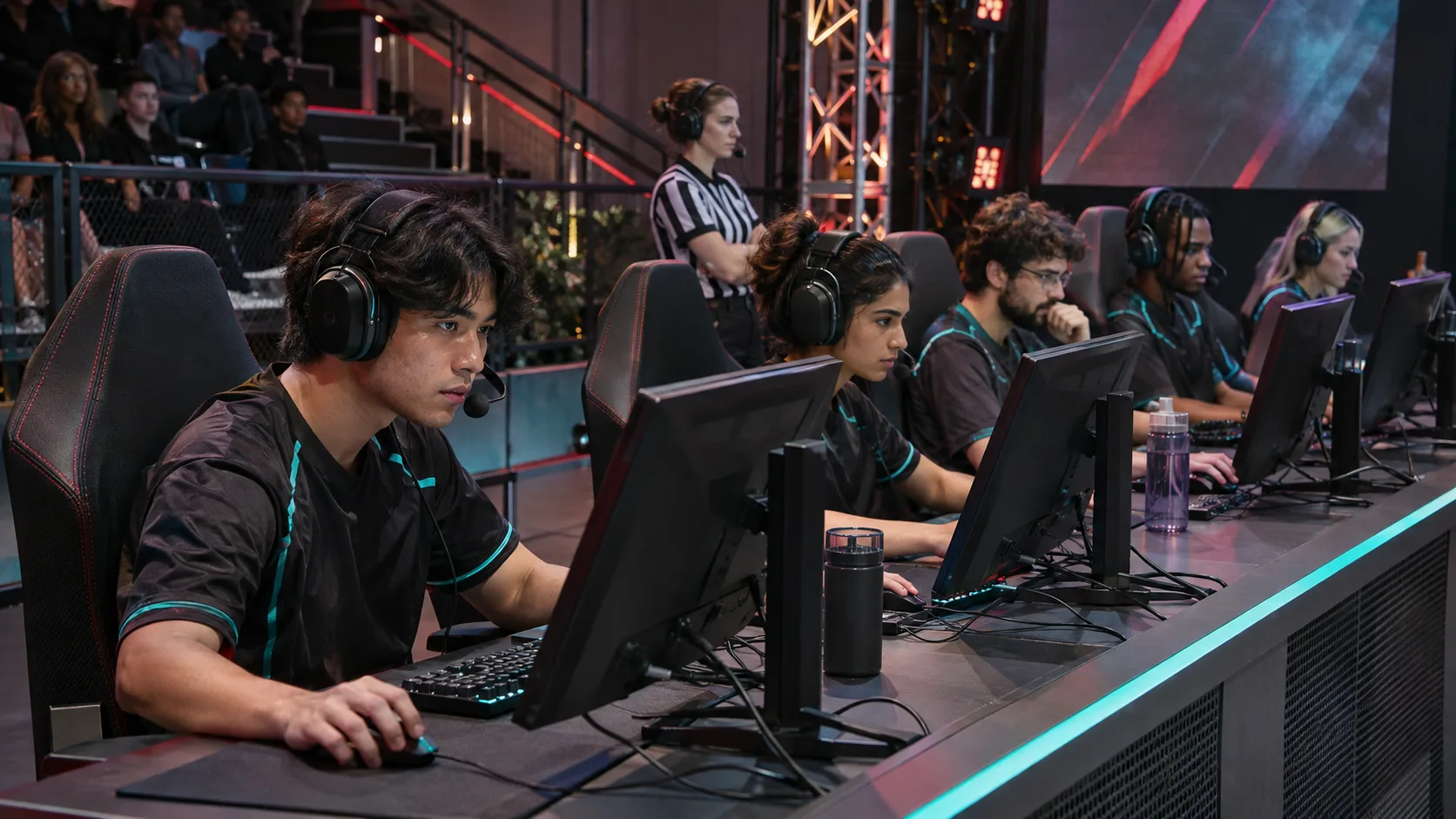
Table of Contents (46 sections) ▼
Esports games are video games played as organized player-versus-player competition. The participants may be amateurs, students or full-time professionals, and matches may happen online or at live venues. What turns ordinary competitive gaming into esports is the surrounding structure: agreed rules, repeatable matches, tournaments or leagues, skilled participants and an audience that can follow the result.
That distinction matters because not every multiplayer game is automatically an esport. A game can have ranked matchmaking without a lasting tournament scene. It can also become an esport through community-run events long before its publisher creates a professional league.
This guide explains the difference between gaming and esports, the qualities successful esports games tend to share, the main genres and the easiest ways to start competing or watching.
What are esports games?#
Esports is short for electronic sports and generally means competitive video gaming between human players. Individuals or teams compete under a defined ruleset to produce a winner. The British Esports Federation describes esports as player-versus-player competitive gaming that is commonly organized through leagues, tournaments or other events.
The definition covers far more than major arena finals. These can all be esports:
- a local fighting-game bracket held in a community venue;
- a school Rocket League league;
- an online Counter-Strike qualifier;
- a professional League of Legends season;
- a mobile-game championship;
- a grassroots tournament operated by players rather than the publisher.
Prize money is common at the professional level, but it is not a requirement. A community cup played for recognition can still be esports if the competition is organized, the rules are clear and players are trying to defeat one another.
Gaming vs esports: what is the difference?#
Gaming is the broad activity of playing video games. Esports is one competitive part of that activity.
| Gaming | Esports |
|---|---|
| Can be single-player, cooperative or competitive | Centers on structured competition between players |
| May have no formal result beyond finishing or having fun | Produces a winner through an agreed ruleset |
| Can be played privately | Usually supports spectators, standings or recorded results |
| Does not require standardized settings | Needs consistent conditions for meaningful competition |
| Can focus on story, exploration or creativity | Focuses on repeatable tests of player or team skill |
A casual match of VALORANT with friends is gaming. The same title played in a scheduled bracket with team rosters, map rules, officials and a broadcast becomes esports. The software is the same; the competitive context is different.
What makes a game an esport?#
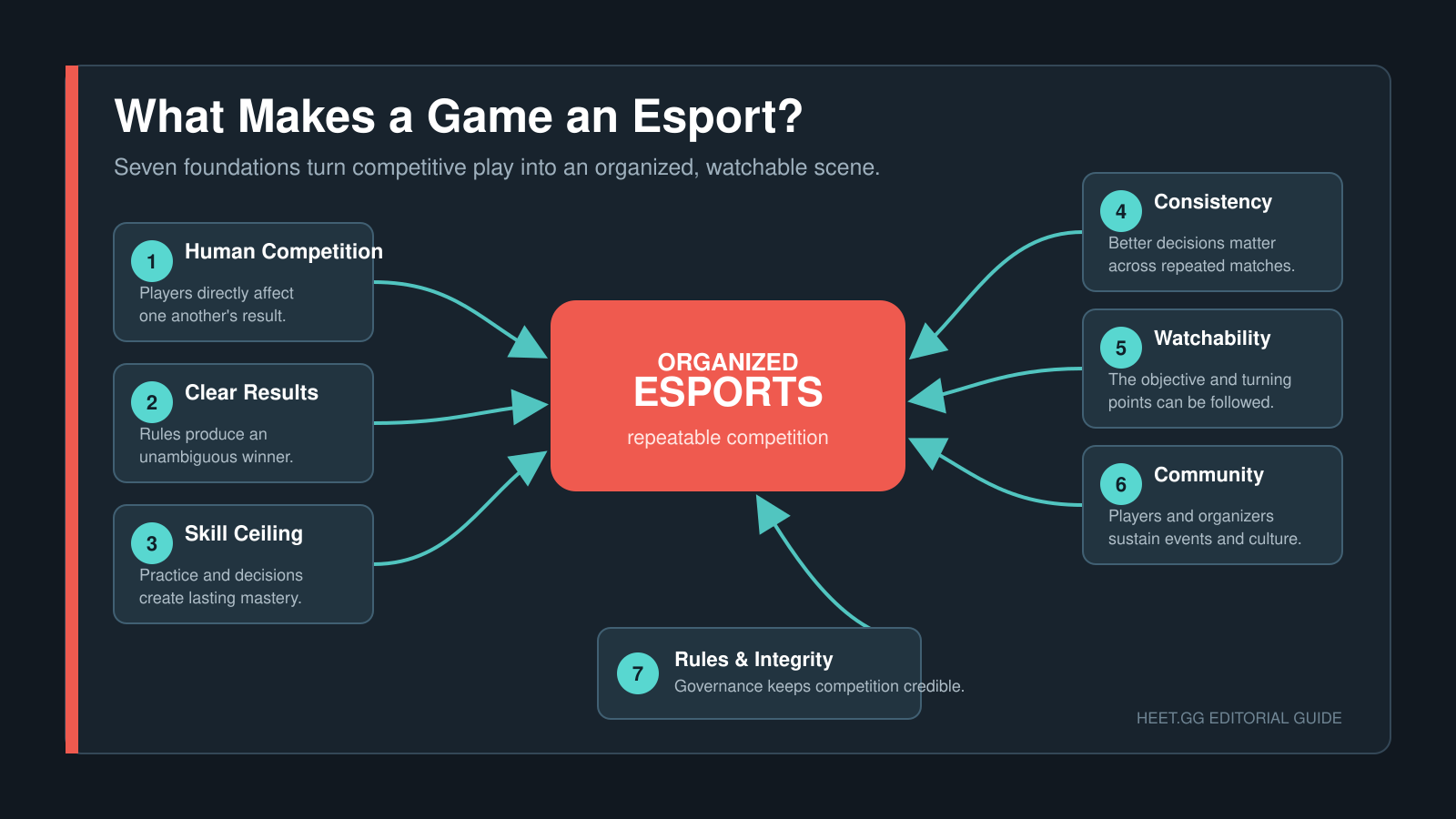
There is no universal certification that turns a video game into an esport. However, durable esports games usually combine seven qualities.
1. Direct competition between players#
Esports needs meaningful human opposition. Players may compete one-on-one, in teams or in a large field, but their decisions must affect who wins.
That is why speedrunning is normally treated as a separate competitive discipline. Speedrunners compare performances and attend events, yet they usually challenge a game and a clock rather than directly interacting with an opponent in the same match. The distinction is organizational, not a judgment about skill.
2. A clear and measurable result#
Viewers and competitors need to know how victory is decided. The result may come from destroying an objective, winning rounds, scoring goals, surviving longer or taking a best-of series.
Strong competitive formats also reduce ambiguity. Tie-break rules, overtime, map selection and disconnect procedures prevent an event from improvising important decisions after a match begins.
3. A high skill ceiling#
Successful esports games create room for players to keep improving. Mechanical execution may matter, but the deepest games also reward decision-making, adaptation, communication, resource management and preparation.
A high skill ceiling does not mean a game must be difficult to understand at first glance. Rocket League has an immediately recognizable goal, yet its movement, positioning and team coordination allow years of mastery. Fighting games use a small arena and a visible health bar, while spacing, timing, matchups and mental pressure create enormous depth.
4. Competitive consistency#
The game must produce results that reflect player decisions often enough for competition to feel legitimate. Randomness is not automatically disqualifying. Card games, battle royales and strategy games can contain uncertain outcomes while still rewarding better decisions over multiple rounds or matches.
Tournament formats help manage variance. A best-of series gives players more chances to adapt and makes one unusual moment less decisive. Seeding, group stages and double-elimination brackets can also produce a fairer test than a single match.
5. Spectator clarity#
An esport needs to be watchable. Spectators should be able to identify the objective, understand the score and recognize decisive moments. Broadcast tools such as observer modes, replays, clean interfaces, player cameras and statistics make complex games easier to follow.
Clarity does not require simplicity. MOBAs can place ten players, dozens of abilities and several objectives on one map. Good observers and commentators turn that complexity into a readable story by showing the most important action and explaining its consequences.
6. A committed player and organizer community#
Communities often create esports before publishers formalize them. Players agree on rules, organize brackets, develop strategies, record results and teach newcomers. Tournament organizers then provide schedules, officials, venues and broadcasts.
A large player base helps, but size alone is not enough. A smaller title with reliable events and dedicated competitors may have a healthier esports scene than a popular game with little interest in structured competition.
7. Rules, support and competitive integrity#
Long-term competition needs more than the game client. Organizers require rulebooks, server access, anti-cheat systems, dispute procedures and a way to handle patches. Professional circuits also need roster rules, eligibility standards and penalties for misconduct.
Publisher support can strengthen these systems, but esports can be publisher-operated, licensed to tournament companies or led by independent communities. Fighting games are a useful example: local organizers and open brackets remain central even when publishers run official tours.
The main esports game genres#
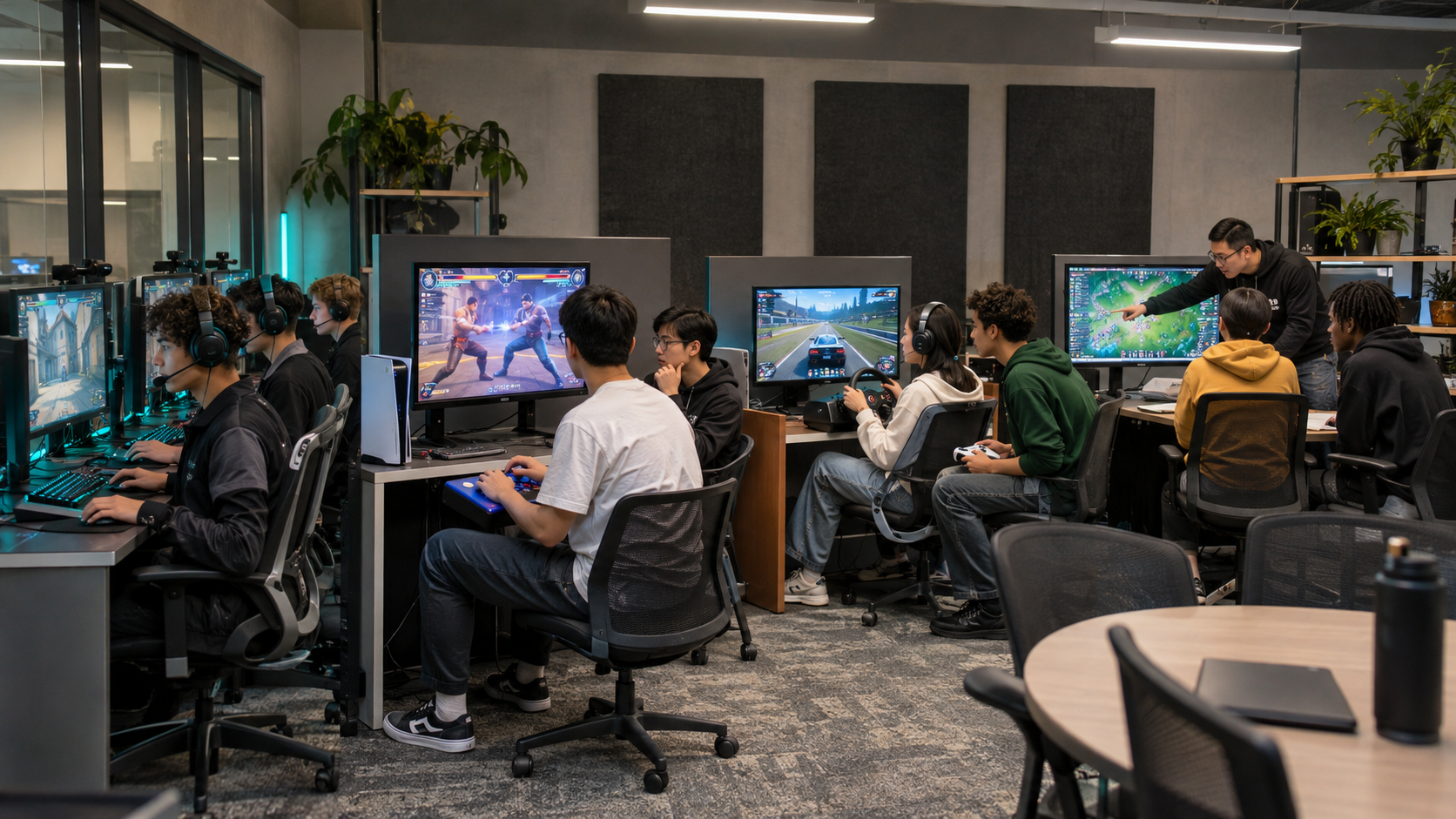
The term esports games describes many different competitive formats. Knowing the genre tells you more about the core skills and viewing experience than the esports label alone.
| Genre | Typical objective | Skills viewers can watch for | Representative games |
|---|---|---|---|
| Tactical shooter | Win rounds through eliminations or objectives | Aim, utility, information, positioning, economy | Counter-Strike 2, VALORANT, Rainbow Six Siege |
| MOBA | Destroy the opposing base | Drafting, lanes, resources, rotations, team fights | League of Legends, Dota 2 |
| Fighting game | Deplete the opponent's health across rounds | Spacing, reactions, combos, matchup knowledge | Street Fighter, Tekken, Guilty Gear |
| Sports and vehicle competition | Outscore the opponent | Mechanics, formations, tempo, adaptation | EA Sports FC, Rocket League, racing simulators |
| Battle royale | Survive and score across a large field | Rotations, survival, engagements, risk management | Fortnite, PUBG, Apex Legends |
| Real-time strategy | Build, manage and defeat an opponent in real time | Economy, scouting, production, control | StarCraft II, Age of Empires IV |
| Digital card game | Reduce an opponent's resources or health through deck play | Deck construction, probabilities, sequencing | Hearthstone, Magic: The Gathering Arena |
| Arena or hero shooter | Complete team objectives with specialized characters | Team composition, ability timing, positioning | Overwatch 2 and similar team shooters |
These categories overlap. Rocket League resembles a sport but uses vehicle physics unique to video games. VALORANT combines tactical shooting with character abilities. Fortnite mixes battle royale play, building and live-service updates. An esport succeeds because its complete ruleset creates compelling competition, not because it fits perfectly into one label.
How esports competitions are structured#
Organizers use different formats to balance competitive fairness, time and entertainment.
Open qualifiers#
Open qualifiers allow eligible players or teams to enter. They create a visible path from amateur competition into stronger events, although the number of entrants often means early rounds use compact formats.
Leagues and round robins#
In a league, competitors play across a season. A round robin gives each participant a scheduled set of opponents, making consistency more important than one exceptional run. Standings then determine a champion or qualification for playoffs.
Single-elimination brackets#
One match or series eliminates the loser. This format is easy to follow and creates immediate stakes, but a strong competitor can leave after one poor performance.
Double-elimination brackets#
Competitors are eliminated after two match losses. Winners and lower brackets create more matches and allow recovery, although the structure requires additional time and careful scheduling.
Swiss systems#
Players or teams face opponents with similar records across several rounds. Swiss formats can manage large fields without requiring every competitor to play everyone else.
Best-of series#
A match may contain several games or maps. Best-of-three and best-of-five series reward adaptation and reduce the effect of one map, draft or unexpected result. The exact format depends on game length and event logistics.
You can see how these structures appear in practice through HEET's upcoming esports tournaments and live and upcoming match schedule.
The people behind an esports match#
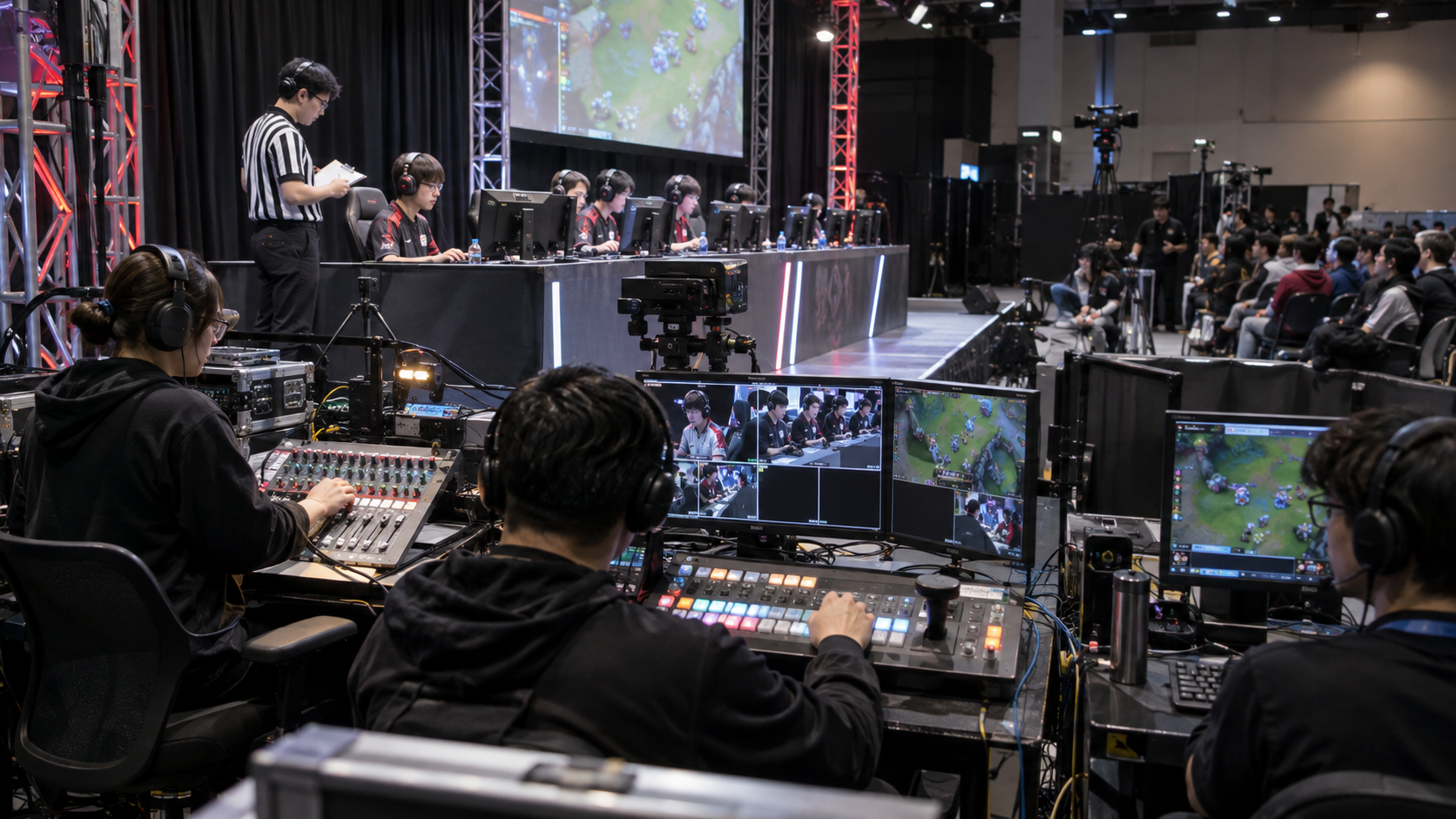
Players are the visible center of competition, but a reliable event depends on many roles:
- coaches prepare strategy, practice and review;
- analysts study opponents, drafts and match data;
- tournament administrators enforce rules and resolve disputes;
- observers select the in-game action shown on broadcast;
- casters describe the match and explain why decisions matter;
- producers coordinate video, audio, graphics and timing;
- referees monitor player conduct and technical conditions;
- team managers handle schedules, travel and administration;
- community organizers create local and online opportunities.
This wider ecosystem is one reason esports is more than ranked matchmaking. A leaderboard can identify strong players, but organized competition turns their performance into scheduled, governed and watchable matches.
Why some popular multiplayer games never become major esports#
Popularity helps an esport attract players and viewers, but it cannot solve every competitive problem.
The game is difficult to observe#
A match may be exciting to play but confusing to watch. If important information is hidden or action happens simultaneously across too many locations, a broadcast needs strong spectator tools to tell a coherent story.
Results contain too much uncontrolled variance#
Randomness can create adaptation, but competitors need enough influence over the outcome. If better decisions rarely produce better long-term results, serious competition struggles to establish credibility.
Updates repeatedly disrupt competitive play#
Regular patches can keep a game fresh. They become a problem when major changes arrive immediately before events, introduce unstable features or force organizers to use different versions without clear support.
Organizers cannot run events sustainably#
Community tournaments need practical licensing rules, private lobbies, administration tools and reliable servers. A game may have competitive potential while offering organizers no workable way to operate brackets.
The community prefers another style of play#
Players decide what a game's culture becomes. A cooperative or creative community may have little appetite for formal competition even when the game technically supports it.
Are esports only for professional players?#
No. Professional esports is the most visible level, not the complete activity.
The path into organized competition can include:
- casual matches between friends;
- in-game ranked play;
- community cups and ladders;
- school, university or local leagues;
- open online qualifiers;
- semi-professional teams and regional events;
- professional leagues and international championships.
Players do not need to treat the ladder as a career path. A weekly amateur league can provide the same appeal as a local sports club: scheduled competition, shared improvement and a community built around the game.
How to start playing esports#
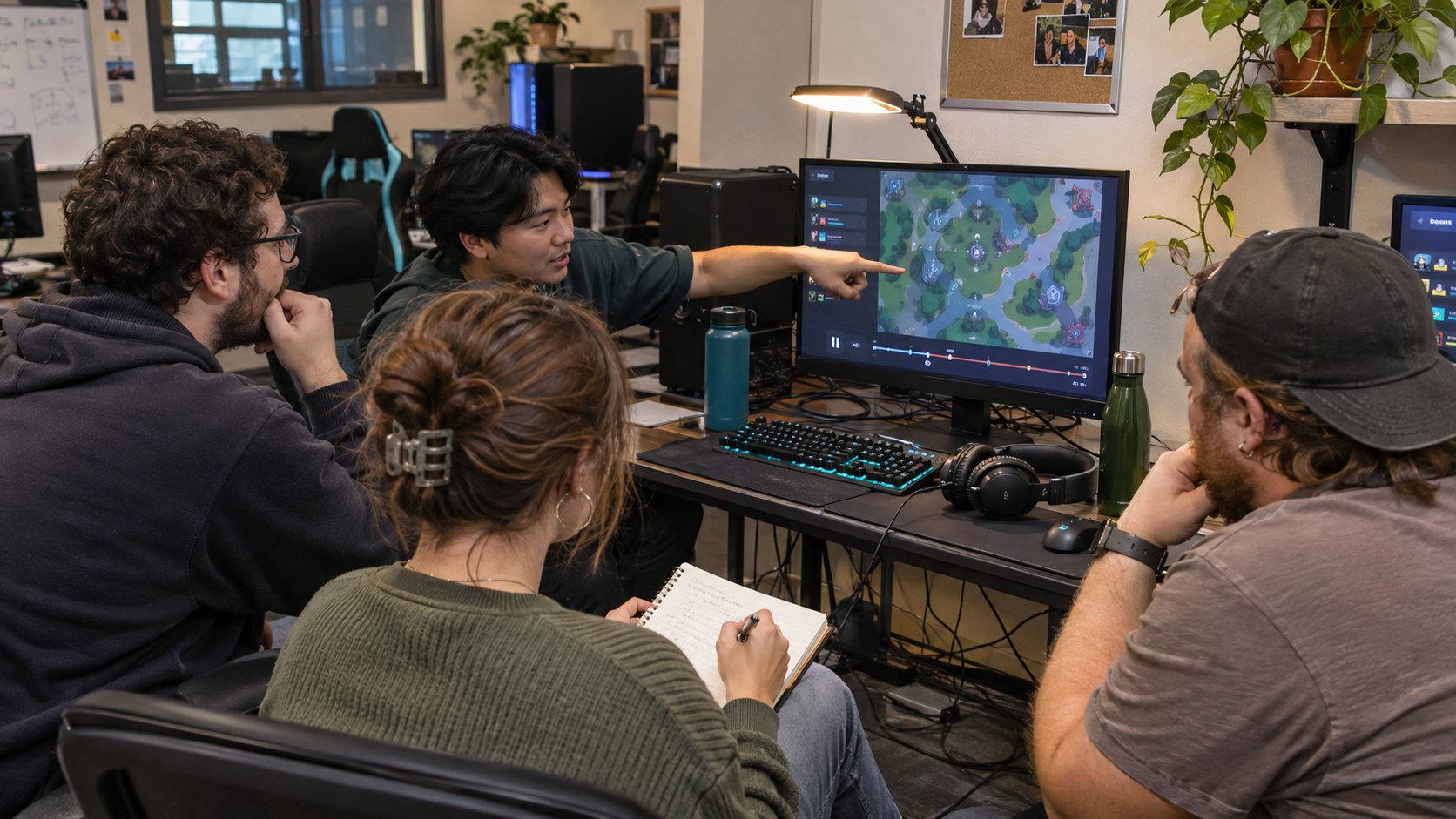
Choose a game you already enjoy#
Improvement requires repetition. Pick a title whose core matches remain satisfying even when progress is slow. Do not choose only because its professional prize pools are large.
Learn one competitive role or ruleset#
Reduce the number of variables at first. Learn a small character pool, one position, a limited set of maps or one reliable strategy. This creates a stable base for reviewing mistakes.
Use ranked play as practice, not proof of identity#
A rank is feedback from a matchmaking system. It is not a complete measure of communication, teamwork or tournament performance. Focus on repeatable decisions instead of protecting a badge.
Review one problem at a time#
After a match, identify the earliest decision that created a major disadvantage. Mechanical mistakes are easy to notice, but positioning, information and timing often determine whether the difficult mechanical situation appears at all.
Join beginner-friendly competition#
Look for official community hubs, established tournament platforms, school programs or local groups with published rules. Confirm region, platform, age requirements, anti-cheat policy and schedule before registering.
Build reliable team habits#
Arrive on time, communicate briefly, accept feedback and record agreed strategies. Reliability makes it easier to find teammates than one impressive highlight followed by repeated absences.
HEET's strategy guide library can help you explore game-specific fundamentals, while the Dota 2 guide section shows how detailed competitive concepts can become once you choose a title.
How to start watching esports#
An unfamiliar broadcast can feel overwhelming. Use this sequence:
- Learn the win condition. Know what ends a round, map or game.
- Follow the score. Ignore advanced statistics until the basic match state makes sense.
- Track one player or role. This reduces visual overload and reveals repeated responsibilities.
- Notice limited resources. Economy, cooldowns, draft choices and time often explain why a team cannot simply repeat a play.
- Listen for consequences. Good commentary connects one decision to the next objective or fight.
- Watch a full series. Adaptation between games is one of the clearest differences between ranked play and organized esports.
Live esports is easiest to learn when the schedule and bracket are visible. HEET's Dota 2 tournament hub is one example of a game-specific route into current competitions.
Essential esports terms for beginners#
- Best-of-three (Bo3): the first competitor to win two games or maps wins the series.
- Bracket: the structure showing who plays whom and how competitors advance.
- Draft: a selection phase for characters, maps or other competitive options.
- LAN: an event where competitors play at the same physical location on a local network.
- Meta: the strategies, characters or approaches currently considered effective.
- Qualifier: an event that awards entry into a later competition.
- Roster: the registered players representing a team.
- Scrim: a practice match between competitors.
- Seed: a placement used to arrange initial matchups.
- Split: one portion of a longer competitive season.
Frequently asked questions#
Is every competitive video game an esport?#
Not automatically. A competitive mode gives a game esports potential, but an esport also needs organized play, agreed rules and participants who sustain a competitive scene. The scene can be small or community-led.
Does an esport need prize money?#
No. Prize money can attract professional players and attention, but school leagues, amateur cups and local brackets can still qualify as esports without cash prizes.
Are esports games only played on PC?#
No. Esports can run on PCs, consoles and mobile devices. The appropriate platform depends on the title and tournament rules.
Are esports the same as online gaming?#
No. Online gaming describes playing through a network. Esports describes structured competition. An esport may be played online or at an in-person LAN event.
Can a single-player game be an esport?#
Most definitions emphasize player-versus-player competition. Activities such as racing against recorded times or speedrunning can be highly competitive, but they are often organized as separate disciplines unless players directly compete under the same event rules.
What are the biggest esports game genres?#
Common genres include tactical shooters, MOBAs, fighting games, sports games, battle royales, real-time strategy games, digital card games and team-based hero shooters. Popularity varies by region, platform and year.
Who owns an esport?#
The publisher or other rights holder usually controls the underlying game and intellectual property. The competitive ecosystem may be operated by that rights holder, licensed tournament companies or community organizers working under the applicable rules.
Are esports considered sports?#
The answer depends on the organization and jurisdiction. The International Olympic Committee has discussed competitive esports as a potential sporting activity while also identifying governance and values requirements. For practical purposes, esports is most clearly defined as organized competitive video gaming.
What is the easiest esport to understand as a viewer?#
Games with familiar objectives are often easiest at first. Rocket League resembles football with cars, fighting games use visible rounds and health bars, and tactical shooters use clear attacking and defending objectives. The best starting point is still a game you find interesting.
The simple definition to remember#
Esports games are not defined by arena size, prize money or professional contracts. They are defined by organized competition between players.
A strong esport gives competitors meaningful control, produces understandable results and supports a community that can organize, govern and watch matches. Everything else, from local brackets to global championships, grows from those foundations.
HEET Precision Tools Hub
Sharpen your mechanical gameplay with our suite of esports utilities. Benchmark your reaction time, replicate professional player crosshair codes, and convert mouse sensitivity across games.