
Game Engines Explained: What They Do and Why They Matter
Game engines power far more than graphics. This gamer-focused guide explains rendering, physics, animation, networking, mods and performance, plus how Unreal, Unity, Godot, Source 2 and proprietary engines differ.
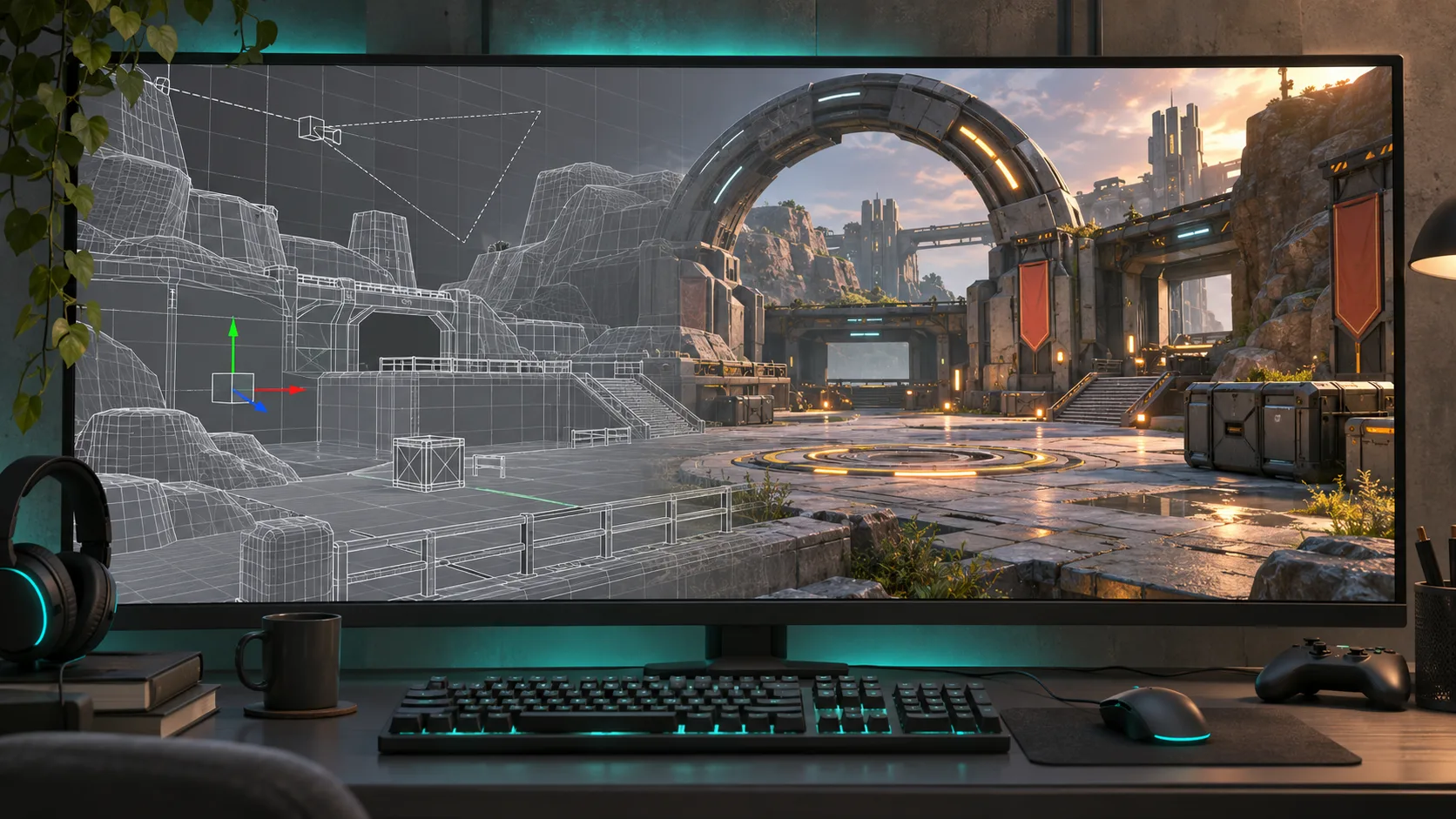
Table of Contents (46 sections) ▼
Game engines are reusable software platforms that provide the core systems needed to build and run video games. They can render graphics, simulate physics, play audio, read controller input, animate characters, manage assets, run gameplay code and connect players over a network.
The engine is not the game itself. Developers still create the rules, worlds, characters, art, sound, levels and moment-to-moment experience. Think of the engine as the technical foundation and toolset that lets all those creative parts work together in real time.
That distinction matters for players. An engine can influence how a game is built, optimized, patched and modded, but an engine logo does not determine whether the final game will look good, run smoothly or be fun.
What is a game engine?#
A game engine is a collection of reusable systems and development tools for creating interactive software. Instead of writing a renderer, physics simulation, input layer and asset pipeline from zero for every project, a studio can build on an existing engine.
Some engines are available to many developers. Unreal Engine, Unity and Godot are examples of general-purpose engines used across unrelated projects. Other engines are proprietary: a publisher or studio develops them primarily for its own games and production needs.
There is no universal checklist that every engine must contain. A small 2D engine may be intentionally focused, while a large commercial engine can include editors, profilers, visual scripting, multiplayer frameworks, cinematic tools and exporters for many platforms.
How a game engine works#
At the center is a repeating process often described as the game loop. In simplified form, the engine:
- reads input from the player and operating system;
- updates gameplay rules, AI, animation and physics;
- prepares audio and network changes;
- renders the next frame;
- repeats the process.
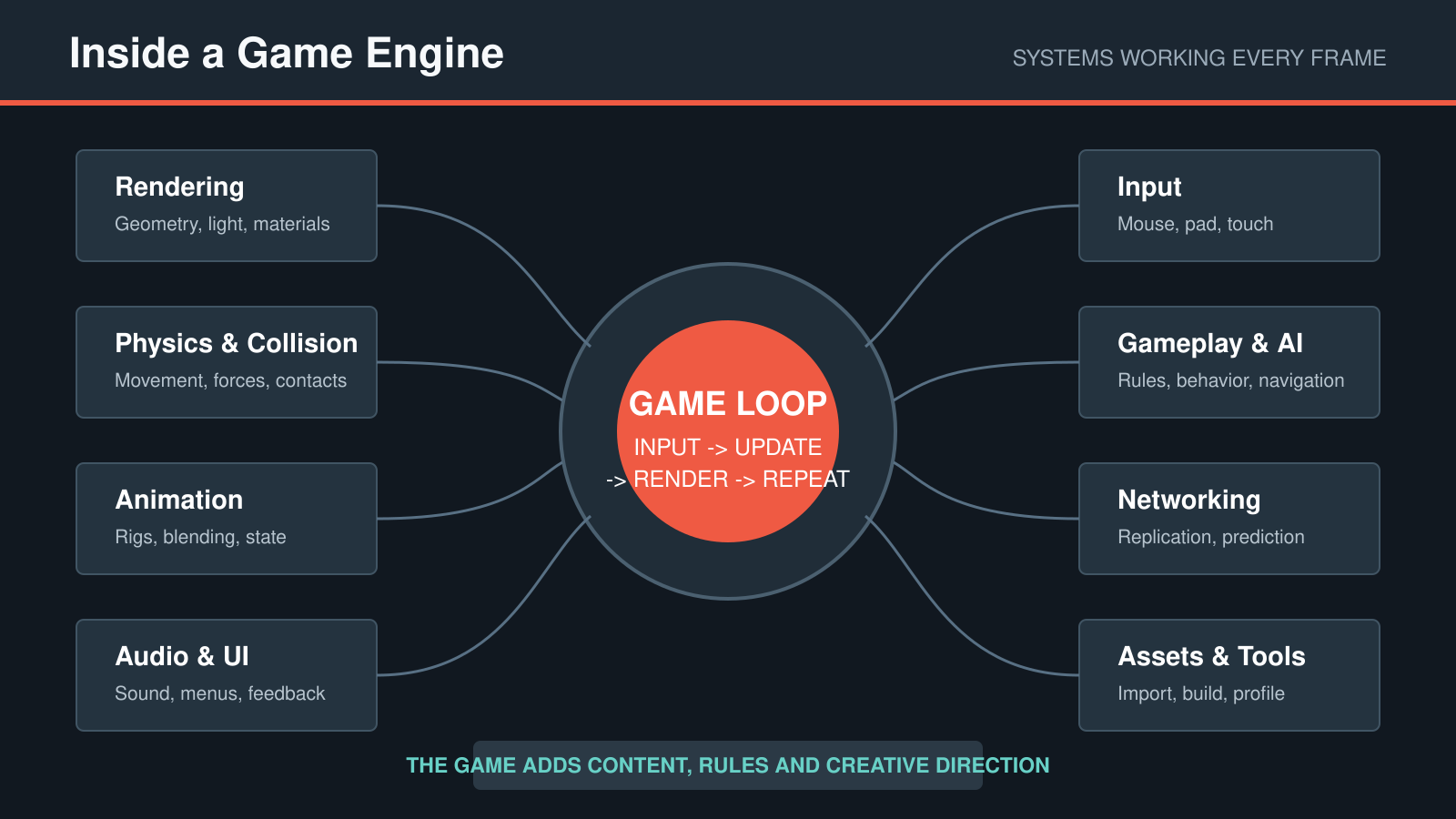
That simplified loop hides a great deal of complexity. Rendering may run as fast as the GPU allows, physics may use a fixed update interval, audio can have its own processing thread, and online games must reconcile local prediction with updates from a remote server.
The engine coordinates those systems so the result feels like one continuous world rather than a collection of separate programs.
What does a game engine actually do?#
1. Rendering graphics#
The renderer turns scene data into the image on your display. It handles geometry, cameras, materials, textures, lighting, shadows, particles, post-processing and the instructions sent to the graphics hardware.
Modern engines may offer several rendering paths for different devices or visual goals. A high-end PC build can use more complex lighting and effects than a mobile version, even when both builds originate from the same project.
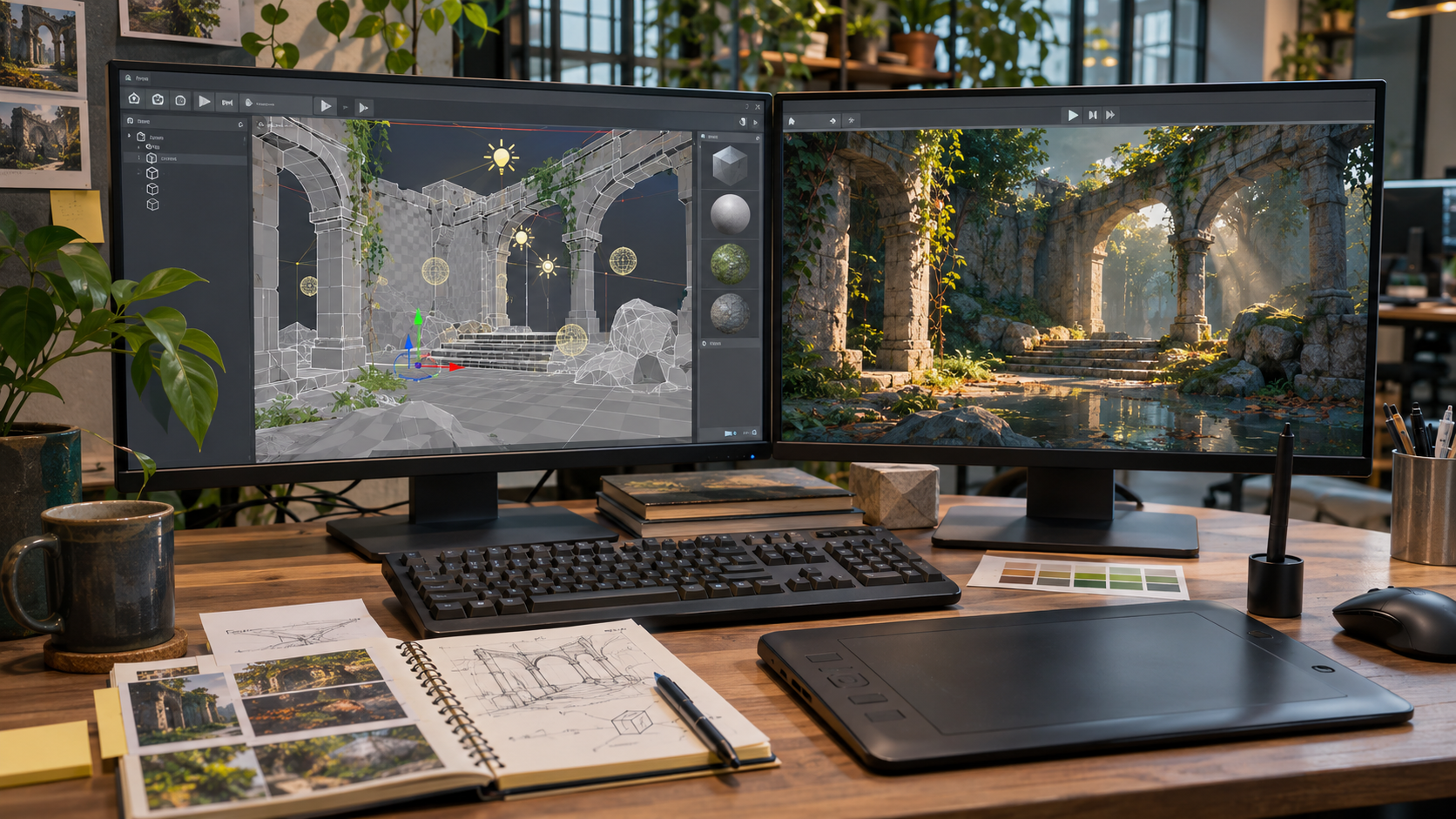
The renderer is not the same as the art. The engine provides techniques and constraints; artists decide how the world looks, and technical artists balance that vision against memory and performance budgets.
2. Physics and collision#
Physics systems calculate movement, forces, gravity, joints and interactions between objects. Collision systems determine whether objects overlap, touch or block one another.
The visible model and its collision shape do not have to be identical. Developers often use simpler invisible shapes because checking every visual triangle would be unnecessarily expensive. This is why a projectile can occasionally appear to touch scenery even though the collision boundary says otherwise.
Physics can be realistic, exaggerated or almost entirely custom. A racing simulator, platformer and tactical shooter need very different movement even when they use the same underlying engine.
3. Character animation#
Animation systems blend movement clips, control skeletons, place feet on surfaces and connect actions to gameplay states. They may combine hand-authored animation, motion capture, procedural adjustments and inverse kinematics.
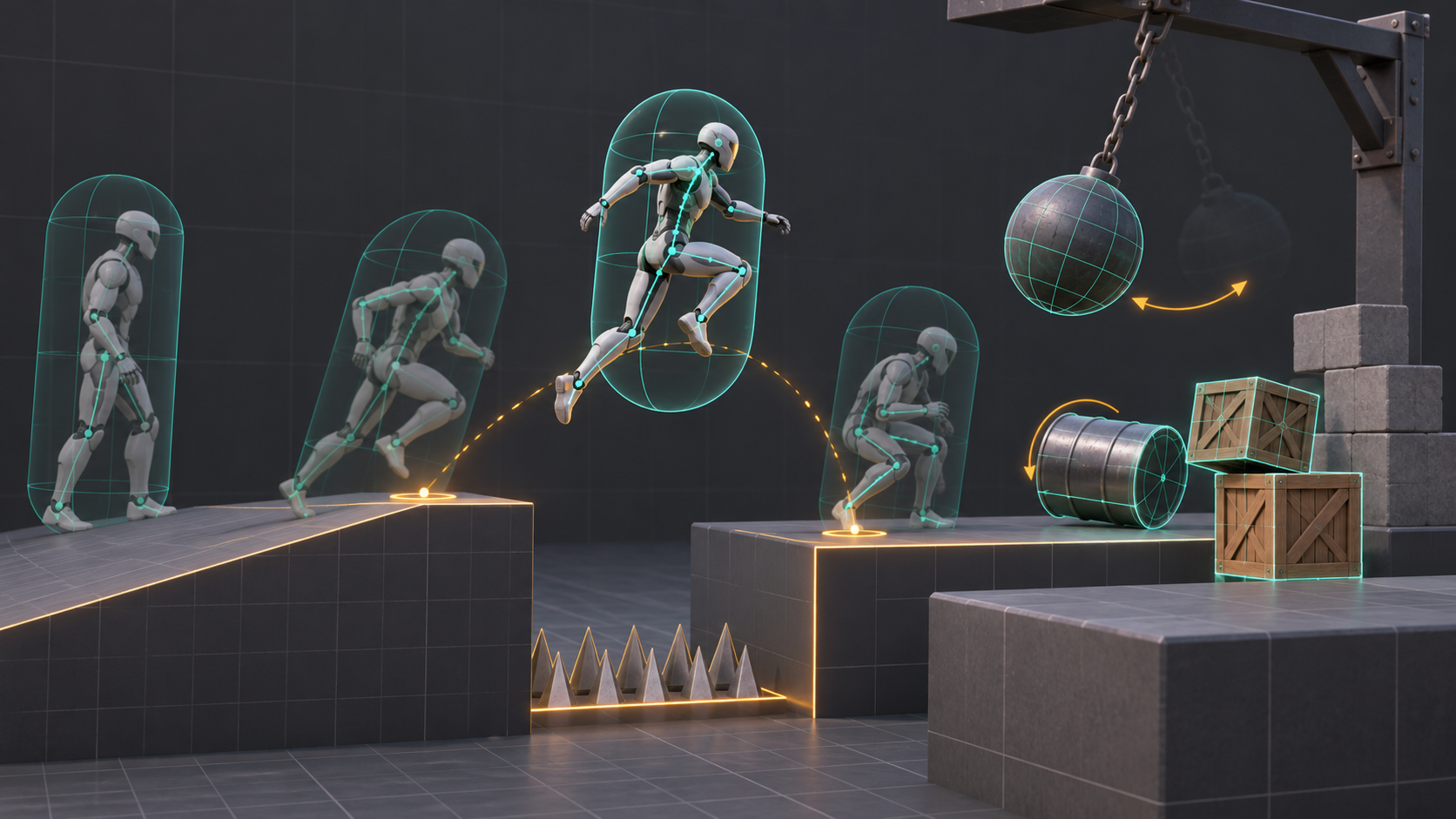
The engine can provide strong animation tools without automatically producing convincing movement. Timing, transitions, responsiveness and the quality of the source animation remain development decisions.
4. Gameplay code and scripting#
Gameplay code defines what the game allows: weapon behavior, abilities, quests, scoring, inventory, enemy logic and countless other rules.
Engines expose these systems through programming languages, visual scripting or both. The reusable engine handles common technical work, while game-specific code creates the identity of the project.
This is one reason two games made in the same engine can feel completely unrelated. Their rules, camera, controls, animation timings and content can all be different.
5. Artificial intelligence and navigation#
Game AI covers systems such as decision-making, target selection, perception and movement through the environment. Navigation tools can calculate paths around level geometry and dynamic obstacles.
An engine may provide behavior trees, navigation meshes or pathfinding utilities, but developers still design the actual enemy behavior. Poor AI is not automatically an engine limitation, just as good AI is not a default engine feature.
6. Audio#
The audio system plays music, dialogue and effects while controlling volume, priority, positioning, reverberation and environmental response. In a competitive game, sound may also communicate distance, direction and game state.
Studios frequently combine the engine's audio features with specialized middleware. The final result depends on sound design, mixing and gameplay logic as much as the underlying technology.
7. Input and user interface#
The engine translates signals from a mouse, keyboard, controller, touchscreen or motion device into actions the game understands. It also helps create menus, HUD elements, subtitles and accessibility interfaces.
Input processing affects responsiveness, but it is only one part of total latency. Frame rate, display behavior, networking and peripheral polling can also contribute. HEET's CS2 settings guide shows how several of those layers interact in a competitive game.
8. Networking#
Multiplayer engines need to send relevant game state between clients and servers. Common systems include replication, prediction, interpolation, matchmaking hooks and server authority.
The engine may provide networking foundations, but developers choose update rates, server architecture, lag compensation and which events must be verified by the server. A game using a well-known engine can still have excellent or poor networking depending on those choices and the infrastructure behind it.
9. Assets, worlds and streaming#
Models, textures, animations, audio and level data must be imported, organized, compressed and loaded at the right time. Large games cannot keep every asset in active memory, so engines stream data as the player moves through the world.
When streaming falls behind, players may notice texture pop-in, missing detail or traversal stutter. The engine provides tools, but storage speed, asset size, memory budgets and project configuration determine the outcome.
10. Editors, profilers and build tools#
The runtime makes the finished game work. The surrounding toolchain helps developers create it.
Typical tools include:
- scene and level editors;
- material and animation editors;
- asset importers;
- visual scripting;
- CPU, GPU and memory profilers;
- automated build systems;
- platform packaging and testing tools;
- crash reporting and debugging support.
These tools can be a major reason a studio chooses one engine over another. Production speed, team experience and platform support can matter as much as a headline graphics feature.
Game engine vs graphics engine#
A graphics engine or renderer focuses on producing images. A game engine is broader: it coordinates rendering with input, gameplay, physics, audio, assets and other systems.
The terms are sometimes used loosely, especially when people discuss a visually distinctive game. It is more accurate to treat rendering as one subsystem within the overall engine.
The graphics API is another separate layer. DirectX, Vulkan and Metal provide ways for software to communicate with graphics hardware. A game engine can support more than one API and select different backends for different platforms.
Game engine vs game framework and middleware#
A framework usually provides code libraries and structure but may offer fewer integrated visual tools. The boundary is not absolute: some products sit between a lightweight framework and a complete editor-driven engine.
Middleware is specialized technology integrated into a larger project. A studio might use separate solutions for audio, physics, vegetation, video playback or online services alongside its main engine.
When a game credits several technologies, that does not mean it uses several complete engines. It often means the primary engine incorporates specialized components.
Popular types of game engines#
There is no single best engine. Each option reflects different priorities, licensing models, workflows and technical trade-offs.
| Engine type | Access model | What distinguishes it | Gamer-facing example |
|---|---|---|---|
| Unreal Engine | Commercial Epic engine with source access under its license | Broad real-time 3D toolset, visual scripting, rendering, world-building and cross-platform production | Used across many independent and large-scale releases |
| Unity | Commercial engine with free and paid plans | Broad platform reach and workflows for 2D, 3D, mobile, desktop, web and other devices | Common across indie, mobile and cross-platform games |
| Godot | Free and open source under the MIT license | Unified 2D and 3D editor with an open codebase and community-driven development | Popular with developers who value control and open licensing |
| Source 2 | Valve's proprietary engine and tools | Valve technology used for its current games and workshop pipelines | Counter-Strike 2 is officially built on Source 2 |
| Studio-owned engines | Proprietary, normally unavailable to outside teams | Can be tailored to a franchise, hardware target or internal production pipeline | Often powers a publisher's related games |
This table is not a quality ranking. A focused proprietary engine may be ideal for one studio, while a general-purpose engine can be more practical for a team that needs established tools and broad platform support.
Unreal Engine, Unity, Godot and Source 2 in plain English#
Unreal Engine#
Epic's official documentation presents Unreal Engine as a broad suite for rendering, gameplay systems, animation, audio, user interfaces, world building, testing and publishing. It supports C++ and Blueprint visual scripting.
For players, the important point is not that every Unreal game looks alike. Studios can replace, extend or heavily customize systems, create different renderers and target very different hardware. Shared technology may produce familiar technical patterns, but it does not impose one art style.
Unity#
Unity describes its engine as a platform for building games and applications across more than 20 platforms. Its wide deployment range is one reason it appears in projects with very different scopes, from 2D games to mobile releases and larger 3D productions.
As with Unreal, the engine name tells you little about the final quality without knowing the project, version, renderer, assets and optimization work.
Godot#
Godot's official documentation describes it as a cross-platform 2D and 3D engine with a unified interface. Its code is available under the permissive MIT license, and the project is community-driven.
Open source means developers can inspect and modify the engine itself. It does not mean every Godot game is open source; creators control the licensing of their own game code and content.
Source 2#
Source 2 is Valve's current engine technology. Valve's official Counter-Strike 2 pages state that CS2 is built on Source 2 and highlight updated rendering and Workshop tools.
Players should still separate engine capability from game-specific implementation. Counter-Strike's movement, networking, maps and tools are designed for that game rather than automatically inherited by every possible Source 2 project.
Proprietary engines#
Some studios build internal engines to control the roadmap, specialize around a franchise or integrate with an established production pipeline. This can offer deep customization and avoid dependence on an outside vendor.
The trade-off is responsibility. The studio must maintain the renderer, tools, platform support, documentation and specialist engineering knowledge. A commercial engine distributes much of that work across the engine vendor and its wider ecosystem.
Does the game engine determine graphics quality?#
No. The engine defines available tools and technical limits, but visual quality also depends on:
- art direction;
- model and texture quality;
- material design;
- animation;
- lighting decisions;
- target hardware;
- resolution and performance targets;
- developer time and expertise.
A stylized low-poly game can use the same engine family as a photorealistic production. That is not evidence that one team used the technology incorrectly; the projects are solving different creative and performance problems.
Does the game engine determine performance?#
The engine matters, but it is not a complete performance verdict. Frame rate and stability depend on the exact engine version, project configuration, content, scripts, shaders, world structure, platform settings and optimization work.
Two games built on the same engine can stress completely different parts of a PC. One may be limited by GPU lighting, another by CPU simulation, and another by asset streaming or shader compilation.
If a game stutters, identify the actual bottleneck before blaming the engine. HEET's PC stuttering and FPS-drops guide explains how frame time, VRAM, storage, drivers and background activity can create similar symptoms.
Why do some games in the same engine share problems?#
Shared technology can create shared patterns. Games using similar versions, rendering features or asset pipelines may encounter comparable shader compilation, traversal stutter or CPU overhead.
That does not prove every game in the engine has the problem. Developers can configure systems differently, backport fixes, modify source code, precompile shaders, redesign content or choose another rendering path.
The useful question is not simply "Which engine is this?" It is "How did this project use and optimize that engine on my platform?"
Why changing engines is difficult#
An engine is deeply connected to project data and production workflows. Moving a game can require teams to rebuild:
- gameplay code;
- materials and shaders;
- physics behavior;
- animation systems;
- level tools;
- asset import rules;
- networking;
- platform integrations;
- internal automation.
Even when two engines support similar features, their data models and workflows may be incompatible. An engine migration is therefore closer to rebuilding the technical foundation than opening the same project file in another application.
Studios sometimes upgrade within an engine family instead. That can preserve more work, but major version changes can still require months of testing and adaptation.
How engines affect ports and cross-platform games#
General-purpose engines can provide exporters and platform abstraction, but a successful port is not a one-click operation. Each device has different memory, storage, graphics, input, operating-system and certification requirements.
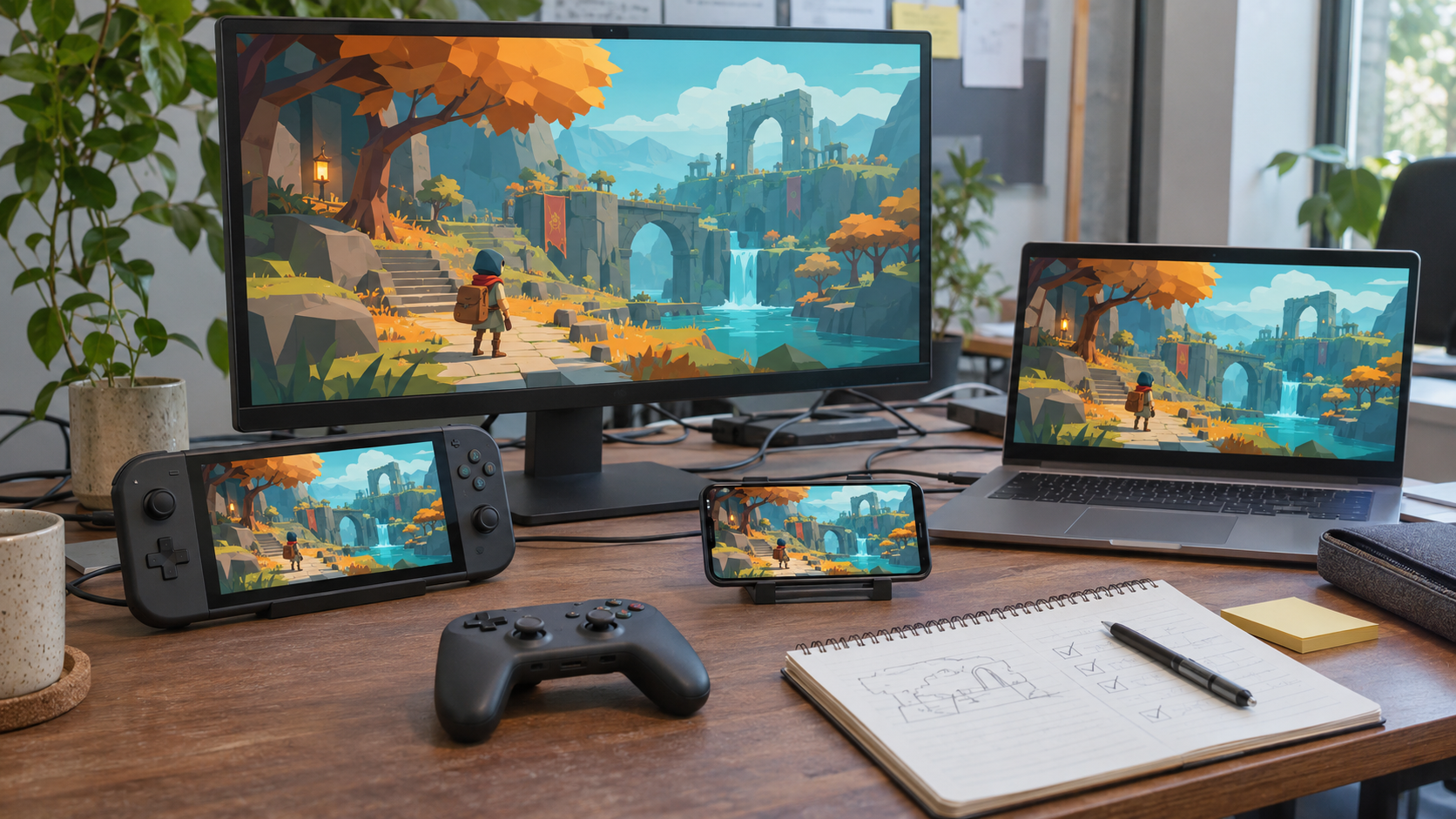
Developers may need to change texture sizes, shaders, effects, controls, user interfaces and world streaming for each platform. Console access can also require platform-holder approval and engine-specific support arrangements.
An engine can make cross-platform development more manageable without eliminating platform engineering.
How game engines affect modding#
Engine architecture influences what modding is technically possible, but developer support is often more important. Useful modding depends on:
- accessible file formats;
- official editors or SDKs;
- scripting access;
- documentation;
- stable Workshop or distribution support;
- clear legal permissions;
- separation between game data and protected online systems.
A powerful engine does not guarantee an open modding scene. A studio can lock down assets and tools, while another studio using comparable technology can actively support creators.
Engine upgrades can also break older mods when APIs, data formats or scripting behavior change. That is why major technical migrations are significant for long-running communities.
How can you tell which engine a game uses?#
Start with reliable sources:
- Check the developer or publisher's official site.
- Read the official store page and system information.
- Check the credits or startup notices.
- Look for developer talks, documentation or official mod tools.
- Treat file names and community databases as clues, not final proof.
An engine splash screen can be useful, but licensing terms may allow it to be removed. Familiar file structures can also mislead when a studio has modified the engine or uses shared middleware.
Common game-engine myths#
"Every game needs Unreal or Unity"#
No. Developers can use Godot, another general-purpose engine, a framework or technology built in-house. The right choice depends on the project and team.
"A newer engine automatically means better graphics"#
No. Newer tools can expand what is possible, but art direction, assets, target hardware and production work decide what reaches the screen.
"Games in the same engine should have the same performance"#
No. Content and implementation can create completely different CPU, GPU, memory and storage loads.
"Open-source engines make the finished game open source"#
Not automatically. Godot's MIT license covers the engine, while developers choose how to license their own game code and assets.
"An engine switch is an easy performance fix"#
Rarely. Rebuilding systems and content in another engine can introduce new bugs, costs and limitations. Teams normally investigate the actual bottleneck first.
"The engine makes the game"#
The engine provides technology. Developers still design, build, test and optimize the experience. Excellent tools cannot replace good production decisions.
Frequently asked questions#
What is the simplest definition of a game engine?#
A game engine is reusable software that combines the core systems and tools required to build and run a video game.
Is a game engine only for graphics?#
No. Rendering is one subsystem. Engines can also handle input, physics, audio, animation, scripting, AI, networking, assets, user interfaces and platform builds.
What is the best game engine?#
There is no universal best engine. The best choice depends on the game type, target platforms, team skills, budget, licensing needs and required tools.
Can you make a game without a game engine?#
Yes. Developers can build directly with programming libraries and platform APIs. As reusable systems accumulate, the project may effectively develop its own engine or framework.
Why do developers build proprietary engines?#
They may want full control, specialized technology, a long-term internal pipeline or features tailored to a particular franchise. The cost is maintaining the technology and tools themselves.
Does Unreal Engine mean a game will have shader stutter?#
No. Shader compilation behavior depends on the project, platform, engine version and implementation. Similar problems can appear across projects, but the engine name alone does not predict the final experience.
Are game engines free?#
Some are. Godot is free and open source under the MIT license. Commercial engines can offer free entry plans, subscriptions, royalties or custom terms. Licensing changes over time, so developers should always read the current official agreement.
Is Source 2 available like Unreal, Unity or Godot?#
Source 2 is Valve's proprietary technology rather than a broadly licensed general-purpose engine in the same way. Players and creators encounter its tools mainly through Valve games and supported Workshop pipelines.
Why game engines matter to players#
Understanding game engines helps players discuss technology more accurately. It explains why an engine update can affect mods, why a port needs optimization, why shader compilation differs between games and why one engine can power projects with completely different visuals.
The most important lesson is simple: the engine creates possibilities and constraints, but the final game reflects thousands of choices made by its developers.
HEET Precision Tools Hub
Sharpen your mechanical gameplay with our suite of esports utilities. Benchmark your reaction time, replicate professional player crosshair codes, and convert mouse sensitivity across games.