
Tactical FPS Games Explained: What Makes a Shooter Tactical?
Tactical FPS games reward information, positioning, teamwork and objective play as much as raw aim. This guide explains the genre, its major subtypes and the habits that help new players improve.
Table of Contents (53 sections) ▼
Tactical FPS games are first-person shooters in which information, positioning, planning and team coordination consistently matter as much as mechanical aim. They make mistakes costly, give objectives real strategic weight and reward players who create favorable fights instead of taking every duel immediately.
The label is not a strict technical standard. Counter-Strike 2, VALORANT, Rainbow Six Siege and Ready or Not all qualify as tactical shooters, yet they approach the idea differently. Some focus on competitive round-based play, while others emphasize reconnaissance, breaching, realistic equipment or cooperative missions.
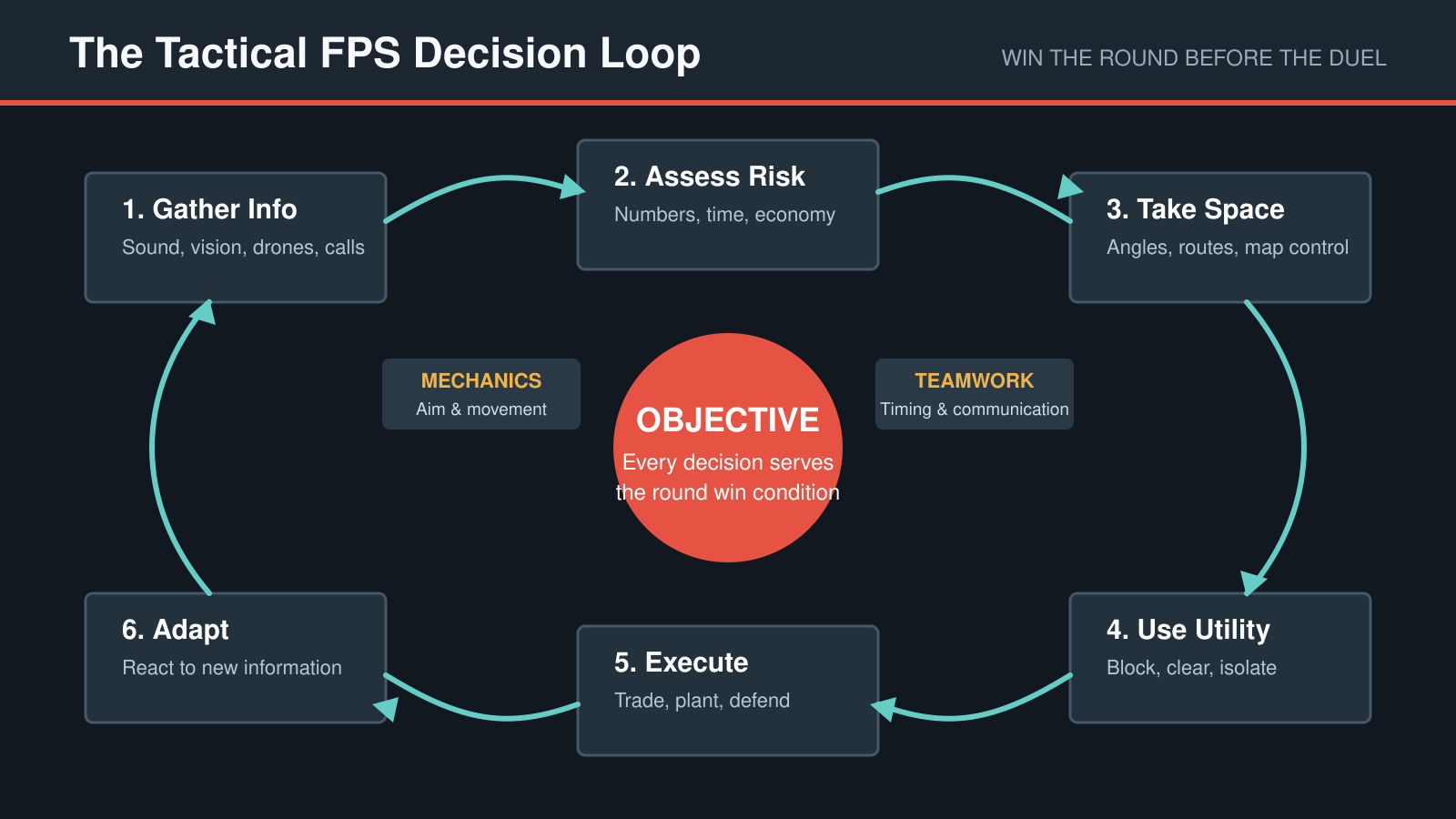
What connects them is a decision loop: gather information, evaluate risk, take useful space, apply resources, execute a plan and adapt when the situation changes.
What is a tactical FPS game?#
A tactical FPS is a first-person shooter designed so that decisions before and during a fight have lasting consequences. Winning usually requires more than faster reactions. Players must understand the objective, predict opponents, manage limited resources, control routes and coordinate their timing.
Common traits include:
- objective-based rounds or missions;
- high lethality or meaningful punishment for mistakes;
- limited respawns, lives or recovery;
- information that must be earned;
- maps built around lanes, cover, chokepoints and rotations;
- utility or equipment that changes the battlefield;
- strong rewards for communication and coordinated action;
- weapon handling that discourages uncontrolled movement or firing;
- economies, loadouts or role choices that affect later decisions.
Not every tactical shooter uses every trait. Realism is also not required. VALORANT uses character abilities and a stylized world while Riot still defines it as a 5v5 tactical shooter. The tactical element comes from consequential choices, structured objectives and counterplay, not from a realistic visual style alone.
The tactical FPS decision loop#
Strong tactical play is a cycle rather than a fixed plan.
text
1. Gather information#
Before committing, learn what you can. Information can come from footsteps, teammate calls, cameras, drones, utility, visible projectiles, missing defenders or a previously cleared area.
Information has an expiry date. A room that was empty ten seconds ago may no longer be safe. Good players communicate both what they know and when they learned it.
2. Assess risk#
Count teammates and opponents, check the remaining time, consider available utility and identify the likely routes. A fair duel may be unnecessary if a coordinated play can create a two-versus-one.
3. Take useful space#
Space matters when it removes options from the opponent or creates new routes for your team. Taking a corridor, doorway or central lane can cut rotations, improve information and make an objective easier to attack or defend.
4. Use utility with a purpose#
Smokes, flashes, walls, drones, traps and breaching tools are not decorations. Each should solve a problem: block a sightline, clear a corner, force movement, gather information or delay an objective.
5. Execute together#
A basic plan becomes much stronger when teammates act at the same time. One player creates pressure, another trades the first engagement, and a third controls the route opponents are likely to use.
6. Adapt#
The first plan rarely survives unchanged. A teammate falls, an enemy rotates, utility misses or the clock becomes the main threat. Tactical skill includes recognizing when the original plan is no longer the best option.
What makes tactical FPS games different?#
Consequences make each action matter#
In many tactical shooters, death removes a player for the rest of the round. That creates a cost for careless movement and turns survival into a resource.
This does not mean passive play is always correct. A calculated entry can be essential. The difference is that aggression should create space, information or an objective advantage rather than exist only for action.
Objectives matter more than the kill count#
Kills help, but they are normally a means to complete the objective. A team can lose despite having more eliminations if it mismanages the clock, abandons the objective or cannot convert an advantage.
The central question is not simply "Can I win this duel?" It is "What does winning or losing this duel do to the round?"
Information is a resource#
Tactical FPS games deliberately limit certainty. Players cannot see the entire map or every opponent. They must build a picture from incomplete evidence.
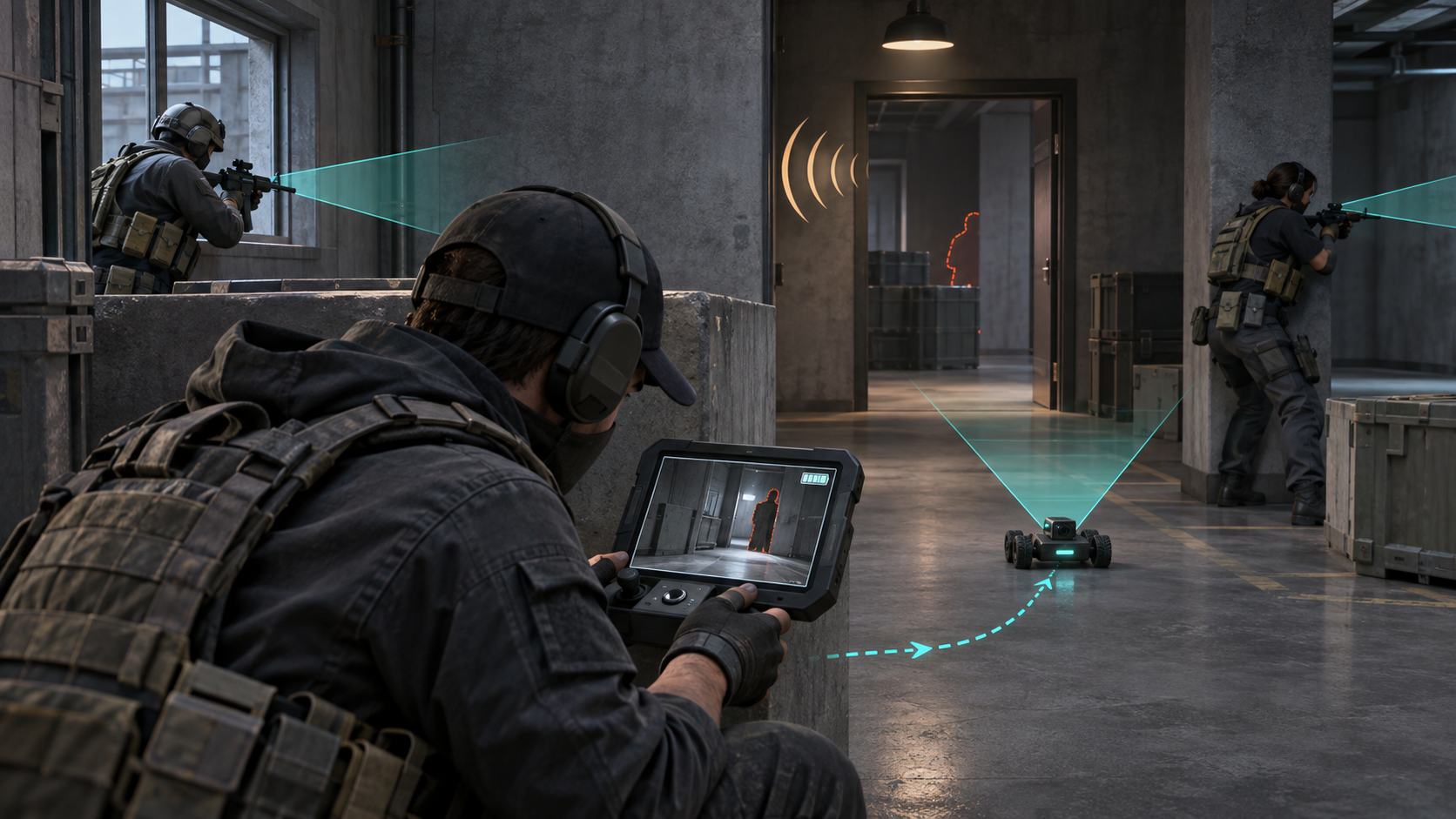
This makes deception powerful. A sound cue, piece of utility or brief appearance can suggest one plan while the real attack develops elsewhere. At the same time, teams must avoid overreacting to a single clue.
Map control creates favorable fights#
Map control means owning or safely contesting useful areas. It determines which rotations are possible, where information can be gathered and which angles opponents must respect.
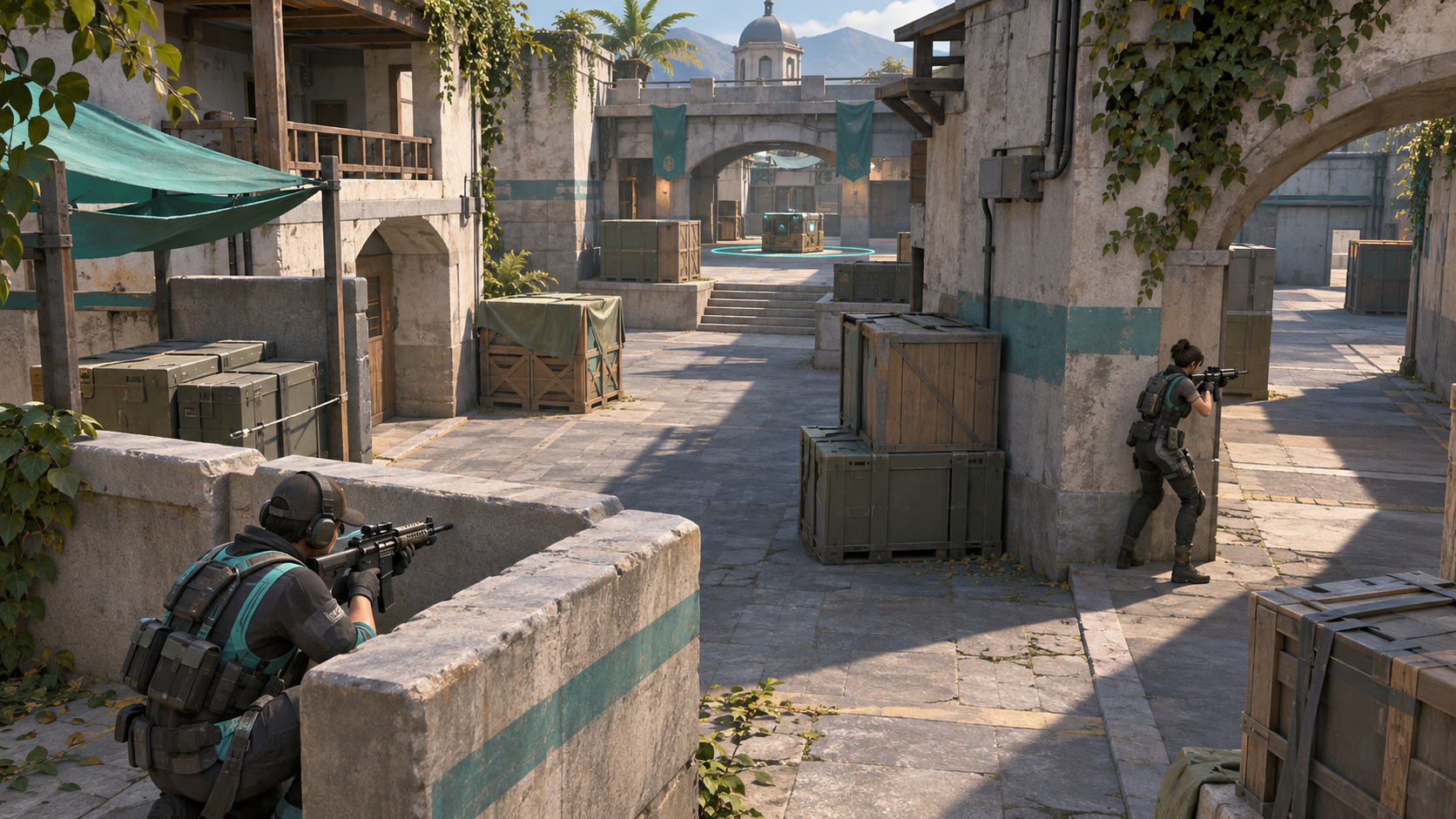
Good spacing is part of map control. Teammates should be close enough to support or trade one another without standing so close that one grenade, spray or angle defeats both.
Utility reshapes the battlefield#
Utility lets players alter the fight before bullets decide it. Depending on the game, it may:
- block vision;
- reveal a position;
- force an opponent out of cover;
- deny an entrance;
- create a temporary route;
- breach a surface;
- slow a push;
- protect an objective interaction.
The tactical question is not whether a tool is powerful in isolation. It is whether the team uses it at the right time and follows up before its advantage disappears.
Economy and loadouts create long-term decisions#
Some competitive tactical shooters connect rounds through an economy. Spending everything now may create the best chance to win the current round, but it can leave the team poorly equipped later.
Other games replace a shared economy with mission loadouts or operator choices. The principle remains similar: resources should match the plan, map and expected threat.
Weapon handling rewards discipline#
Many tactical FPS games punish inaccurate movement, uncontrolled recoil or poor positioning. The exact rules are game-specific. CS2 and VALORANT place heavy importance on controlling movement around accurate shots, while other tactical shooters emphasize stance, leaning, recoil management or slower room clearing.
Do not transfer one game's mechanical rule blindly into another. Learn how the current game handles movement accuracy, recoil, armor, penetration and damage.
Tactical FPS games are a spectrum#
Genre boundaries overlap. A game can combine tactical shooting with hero abilities, military simulation, survival systems or extraction mechanics.
| Shooter type | Main pressure | Typical structure | Key difference from a tactical FPS |
|---|---|---|---|
| Competitive tactical FPS | Information, economy, positioning and one-life rounds | Teams attack and defend a fixed objective | The reference point for structured tactical play |
| Arena shooter | Movement, weapon control and item timing | Fast respawns and continuous combat | Momentum and mechanical execution usually outweigh cautious objective setup |
| Hero shooter | Character abilities, roles and team composition | Objective modes with repeated fights | Abilities and compositions may dominate more than weapon economy or one-life rounds |
| Military simulator | Realism, communication, logistics and scale | Longer missions across large spaces | Usually simulates more systems and may be slower or less symmetrical |
| Extraction shooter | Survival, loot and deciding when to leave | Persistent gear enters and exits a raid | Long-term risk extends beyond the current match |
| Battle royale | Survival, loot, zone movement and many opponents | Large lobby with a shrinking play area | Teams manage uncertainty across a wider, less controlled space |
| Tactical co-op shooter | Planning, rules of engagement and AI threats | Mission-based player-versus-environment play | Coordination targets a scenario rather than an opposing competitive team |
These categories describe design priorities, not quality. Games can sit between them or change emphasis across modes.
Four ways tactical shooters approach the genre#
The following are examples, not a ranked list.
Counter-Strike 2: economy, map control and utility#
Counter-Strike's competitive structure is built around attackers, defenders, bomb sites, limited round lives and an economy that carries decisions forward. Utility creates temporary openings, while map control and timing determine whether those openings can be used.
Valve's official CS2 page emphasizes dynamic smoke grenades, competitive Premier play and game-state information through sound and visual effects. The core lesson is that mechanical aim is strongest when the team first controls the conditions of the duel.
New players can use HEET's Counter-Strike 2 beginner guide for modes, fundamentals and the differences from earlier Counter-Strike versions.
VALORANT: tactical gunplay with character utility#
Riot describes VALORANT as a 5v5 tactical shooter in which players attack and defend with sharp gunplay and tactical abilities. Each Agent offers different tools, but those abilities are most effective when they create a better gunfight, obtain information or protect the objective.
VALORANT shows why tactical does not mean visually realistic. Its strategy comes from one-life rounds, map control, economy, role interaction and the need to adapt to enemy utility.
Rainbow Six Siege: information and destructible space#
Ubisoft describes Siege around tactical 5v5 attack-versus-defense play, unique Operators and destructible environments. The map is not a fixed set of doorways: players can create or deny sightlines, breach surfaces and use observation tools to build information.
That makes preparation and vertical awareness especially important. A room can be threatened from a wall, floor, ceiling, doorway or remote camera rather than only from the obvious entrance.
Ready or Not: cooperative planning and controlled force#
VOID Interactive describes Ready or Not as a tactical first-person shooter centered on tense police scenarios, with single-player and online cooperative play. Its mission structure puts planning, equipment choice and controlled execution ahead of constant action.
The genre emphasis is different from competitive bomb defusal. Teams plan entries, gather information, control doors and manage mission rules against AI-controlled threats. The same tactical principles remain: information, role clarity, timing and disciplined execution.
How to start playing tactical FPS games#
Choose one ruleset first#
Do not try to learn four games at the same time. Pick one whose structure interests you:
- choose CS2 for a focused economy, utility and gunplay loop;
- choose VALORANT for tactical rounds combined with Agent abilities;
- choose Siege for destructible maps, information tools and Operator roles;
- choose a tactical co-op game when you prefer coordinated missions over ranked competition.
Skills transfer, but each game has its own movement, recoil, maps and terminology.
Learn the win condition before the weapons#
Know how the round ends, what the clock means and which actions force the opponent to respond. A player with average aim who understands the objective can make better decisions than a mechanically stronger player who chases every fight.
Reduce the map to a few routes#
Do not memorize an entire map at once. Start with:
- one route to each objective;
- the most common defensive positions;
- a safe rotation path;
- one useful piece of utility for the route;
- the callouts needed to communicate it.
Add detail after those basics become automatic.
Keep the crosshair where a threat can appear#
Crosshair placement reduces how far you must correct after seeing an opponent. Keep it near likely head or upper-body height and pre-position it for the next dangerous angle.
Do not trace the floor while moving. Look at the place from which the next threat can realistically appear.
Separate movement from accurate firing when required#
In games that heavily penalize movement accuracy, release movement and establish control before committing to precise shots. Other tactical shooters allow different movement techniques, so practice against a wall or target range rather than assuming the same timing everywhere.
Communicate short, useful facts#
A good call answers some combination of:
- where the opponent was;
- how many were seen or heard;
- what utility was used;
- whether the objective is present;
- what route is now open or blocked.
Avoid narrating every thought while a teammate is trying to hear footsteps. Information should help the next decision.
Use utility to create action#
Throwing utility without a follow-up wastes its short window. Before using it, know who will move, what angle it removes and what happens if the opponent does not react.
Learn to trade#
Trading means quickly defeating the opponent who eliminated a teammate. The first player creates contact and information; the second is positioned to respond before the opponent can reset.
Proper trading requires spacing. Too far away and the opportunity disappears. Too close and both players can be caught by the same fire or utility.
A practical 20-minute training routine#
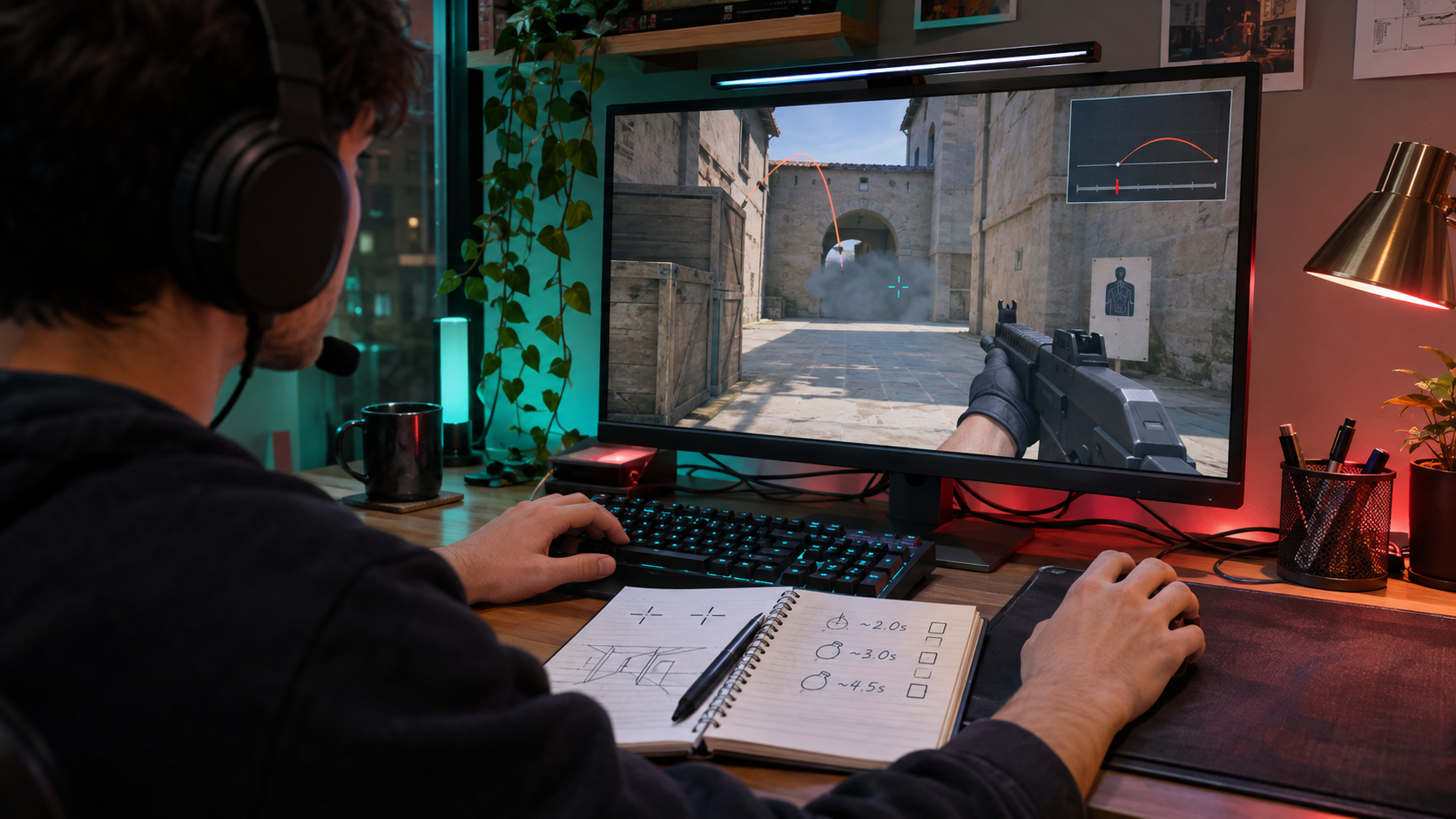
Use a short routine that connects mechanics to real rounds:
- Five minutes of controlled aim: prioritize clean first shots and recoil resets over speed.
- Five minutes of movement practice: stop, peek and fire using the current game's accuracy rules.
- Five minutes of map work: practice one route and one utility sequence from the correct starting position.
- Five minutes of review: inspect two recent deaths and identify the missing information or positioning error.
The routine should create a skill you can use immediately. Endless aim drills will not teach objective timing, rotations or team spacing.
For consistent mouse feel, use the HEET sensitivity converter instead of copying an in-game number between different engines. HEET's CS2 settings guide also provides a practical baseline for visibility, frame-time stability and input consistency.
How to improve in solo queue#
Solo queue reduces coordination, but it does not remove tactical play.
- Give concise information without demanding a complex strategy.
- Play close enough to trade the teammate who is already taking space.
- Fill an uncovered route instead of stacking the most popular position.
- Adapt utility to what the team is actually doing.
- Avoid arguing during the round; useful timing is more valuable than proving a point.
- Track the objective and clock yourself.
The goal is to make your decisions compatible with teammates you cannot fully control.
Common tactical FPS mistakes#
Taking every available duel#
Seeing an opponent does not always mean you should shoot immediately. Consider whether you can gather more information, wait for support or preserve an advantage.
Repeating the same route without adaptation#
A successful play becomes predictable when repeated. Change timing, utility or route when the opponent has shown a counter.
Using all utility at the start#
Early utility can gain space, but saving nothing for the objective, retake or final seconds leaves the team with fewer options.
Rotating on weak information#
One sound or piece of utility does not always represent the full attack. Confirm the threat or maintain a safe anchor before abandoning an objective.
Blaming aim for every death#
Many deaths are decided before the final shot. Poor crosshair placement, isolation, bad timing or missing information can create a duel that was unlikely to succeed.
Copying professional settings without context#
Sensitivity, resolution and crosshair choices must fit your hardware, vision and playstyle. A pro setting is evidence of what works for one player, not a universal answer.
Changing settings after every loss#
Constant changes prevent consistent learning. Establish a workable baseline, keep it for several sessions and adjust only when a repeatable problem appears.
Frequently asked questions#
What is the difference between an FPS and a tactical FPS?#
An FPS describes the first-person shooting perspective. A tactical FPS is a subtype that gives more weight to planning, information, positioning, objectives and costly mistakes.
Are tactical shooters realistic?#
Some aim for realism, but realism is not required. A stylized game can still be tactical when its rules reward information, coordinated utility and consequential decisions.
Is CS2 a tactical FPS?#
Yes. Its round structure, economy, bomb objectives, utility, map control and high consequences make it a central competitive tactical FPS.
Is VALORANT a tactical FPS or a hero shooter?#
It combines elements of both. Riot officially describes it as a 5v5 tactical shooter, while its unique Agents and abilities add hero-based roles. Its one-life rounds, economy and objective structure remain strongly tactical.
Is Rainbow Six Siege a tactical FPS?#
Yes. Ubisoft describes it as tactical 5v5 attack-versus-defense gameplay. Information tools, Operator roles and destructible environments make planning and adaptation central.
Are extraction shooters tactical FPS games?#
Many use tactical shooting principles, but extraction adds persistent loot, survival and the decision to leave the match. It is best treated as an overlapping subgenre rather than an identical format.
Do tactical FPS games require a team?#
Competitive modes are designed around teams, but individual tactical habits still matter in solo queue. Some games also provide single-player or cooperative missions against AI.
What is the best tactical FPS for beginners?#
The best starting point depends on what you want to learn. CS2 offers a focused competitive foundation, VALORANT adds character utility, Siege emphasizes information and destruction, and tactical co-op games allow deliberate team practice without a ranked opponent.
Is aim more important than strategy?#
Both matter. Aim converts an opportunity into a result, while strategy creates better opportunities. As opponents become mechanically stronger, information, timing and teamwork become increasingly important.
Can controller players enjoy tactical FPS games?#
Yes, when the game officially supports the platform and input. Controller aiming, movement and matchmaking rules vary, so use platform-specific settings rather than copying a PC mouse configuration.
The central skill: create a better fight#
Tactical FPS games are not slow shooters by definition. They are shooters in which preparation changes the odds of the next engagement.
Gather information, control useful space, coordinate utility and keep the objective at the center of the plan. Better aim always helps, but the deepest improvement comes from creating fights that are easier to win.
HEET Precision Tools Hub
Sharpen your mechanical gameplay with our suite of esports utilities. Benchmark your reaction time, replicate professional player crosshair codes, and convert mouse sensitivity across games.